.png)


A Modern Guide to the B2B Sales and Marketing Funnel
Let's be honest, the journey a business customer takes from "who are you?" to "take my money" can feel like a complete mystery. The B2B sales and marketing funnel is simply a map of that journey. It's a strategic framework that helps you guide potential customers from their first flicker of awareness all the way to becoming a loyal client.
Think of it less as a rigid set of steps and more as a structured path to predictable revenue growth.
Your Blueprint for Predictable B2B Growth

If you're a B2B leader, you've probably felt the pain of long sales cycles, a pipeline that seems to leak leads at every turn, and a frustrating disconnect between your marketing and sales teams. These aren't isolated problems; they're symptoms of not having a clear system. The game has changed. Today's B2B buyers complete a huge chunk of their research—nearly 70% on average—before they even think about talking to a salesperson.
This guide isn't about abstract theory. It's about tackling those core challenges head-on. We're going to reframe the funnel as an actionable blueprint for sustainable revenue, one that focuses on building a unified system to systematically attract the right kind of prospects.
Why a Structured Funnel Is Non-Negotiable
Without a clear framework, marketing can feel like you're just throwing things at a wall to see what sticks, and the sales team is left sorting through a mixed bag of inconsistent leads. A well-defined funnel brings order to that chaos. It creates a repeatable process for turning complete strangers into paying customers.
For a deeper look into building this kind of predictable engine, check out this guide on the B2B Growth Funnel.
A smart funnel strategy lets you:
- Align Teams: Marketing and sales finally get on the same page, with a shared language and a clear definition of what a qualified lead actually is.
- Improve ROI: You can finally justify marketing spend by clearly tracking how specific activities at each stage directly contribute to closed deals.
- Scale Growth: It helps you build a predictable revenue machine that doesn't rely on random luck or a few heroic individual efforts.
The modern B2B buyer's journey is rarely a straight line. They move between stages, revisit information, and consult multiple stakeholders. Your funnel must be flexible enough to guide them, not force them, through this complex process.
Transforming Your Webflow Site into a Lead Engine
If you're running on Webflow, this is where the rubber meets the road. Your website isn't just a digital brochure; it's the heart of your entire funnel. It's your primary platform for content, engagement, and, most importantly, conversion.
Throughout this guide, we'll get into specific, actionable strategies for turning your Webflow site into an automated lead generation machine. We'll cover everything from attracting high-quality organic traffic with smart SEO to converting those visitors with optimized landing pages and frictionless forms. The goal is to build a rock-solid foundation that makes your website your most effective salesperson.
A Stage-by-Stage Guide to the B2B Funnel
The old, linear B2B sales funnel? It’s a thing of the past. Today's buyers are in the driver's seat, taking a winding, unpredictable path from identifying a problem to finding a solution. Think of the funnel less as a slide and more as a guided journey where you anticipate your buyer's needs at every turn.
To be a good guide, you first have to know who you’re talking to. The entire process hinges on a deep understanding of your ideal customer, which is why the first step is always to create effective B2B buyer personas that capture their real-world goals and challenges.
This level of preparation is crucial because buyers today are incredibly well-informed and self-sufficient. Most complete nearly 70% of their research before ever speaking to a sales rep. And this trend is only accelerating; Gartner predicts that by 2025, a staggering 80% of all B2B interactions will happen on digital channels. A smooth, intuitive online experience isn't a luxury anymore—it's the price of entry.
Let's break down the journey, one stage at a time.
The B2B Funnel Stages at a Glance
Before we dive deep, here's a quick overview of how the buyer's mindset evolves and how your goals should shift to match it at each stage of the B2B funnel.
Funnel StageBuyer GoalMarketing & Sales ObjectiveAwareness"What is my problem?"Educate, inform, and build initial brand recognition.Consideration"How can I solve this problem?"Build trust, demonstrate value, and showcase expertise.Decision"Is this the right solution for me?"Validate their choice and remove final barriers to purchase.
This table serves as our roadmap. Now, let’s explore what's really happening at each of these critical points in the customer journey.
The Awareness Stage: “What Problem Am I Trying to Solve?”
At the very top of the funnel (often called ToFu), people aren't looking for you or your product. Honestly, they probably don’t even know you exist yet. Their world revolves around a problem they're just starting to understand—a nagging pain point, a question without an answer, or an inefficiency they can no longer ignore.
Their mindset is pure discovery. They’re hitting Google, reading articles, and trying to put a name to their challenge. Your job here isn't to sell; it's to educate and inform.
The goal for marketing is to grab their attention with genuinely helpful, problem-focused content. You want to be the best answer to their earliest, most basic questions, positioning your brand as a trusted authority right from the start. A few well-chosen demand generation tactics can make a huge difference in attracting the right kind of attention.
At the Awareness stage, your goal is simple: Be present and be helpful. Your content should be the lighthouse that guides prospects who are lost in the fog of a business problem, showing them a clear path forward.
The Consideration Stage: “How Can I Solve This Problem?”
Once a prospect can clearly define their problem, they move into the middle of the funnel (MoFu). Their search pivots from defining the "what" to exploring the "how." They are now actively researching and comparing different types of solutions.
This is the evaluation phase. They're weighing various approaches, methodologies, and, yes, different vendors. They're thinking critically, looking for proof that a particular path can actually solve their problem without creating new ones.
Your mission is to build trust and prove your unique value. It’s time to go deeper than high-level blog posts. You need to provide practical, in-depth content that showcases your expertise and clearly separates you from the noise of the competition.
- The Buyer's Goal: Evaluate different solutions and figure out which approach is the best fit for their specific situation.
- Your Objective: Nurture that budding relationship with detailed, educational content that builds your credibility and proves your solution works.
The Decision Stage: “Is This the Right Solution for Me?”
Welcome to the bottom of the funnel (BoFu). By now, the prospect has done their homework and narrowed the field to a small handful of options, including you. They understand the landscape and are ready to make a choice. Their mindset shifts to validation and justification.
They’ll be asking sharp, specific questions about features, pricing, implementation, and ROI. They’re hunting for social proof—case studies, testimonials, reviews—and hard evidence that will make them feel confident in their final decision and help them sell it internally to other stakeholders.
Here, your objective is to make it incredibly easy for them to choose you. This means providing clear, comparison-focused materials and knocking down any final barriers to purchase. Your marketing assets should directly support the sales team's final push, giving them everything they need to get the deal signed.
Mapping Your Content to the Funnel
Putting funnel theory into practice is all about delivering the right message to the right person at the right time. Think of your content strategy as the engine driving your B2B sales and marketing funnel; it's what systematically pulls prospects through from their very first click to the final handshake.
The questions people ask change as they get closer to a decision, and your content has to evolve with them.
If you don't get this alignment right, your marketing can feel completely random. A prospect just starting their research (Awareness) doesn't care about your pricing page, and someone deep in vendor comparison (Decision) has no time for another 101-level blog post. Mapping your content creates a logical, smooth journey that builds trust and keeps the momentum going. This all hinges on knowing your audience inside and out. For a masterclass on that, check out our guide on how to create buyer personas.
This map gives you a great visual of the journey, linking different content types and metrics to each stage of the funnel.
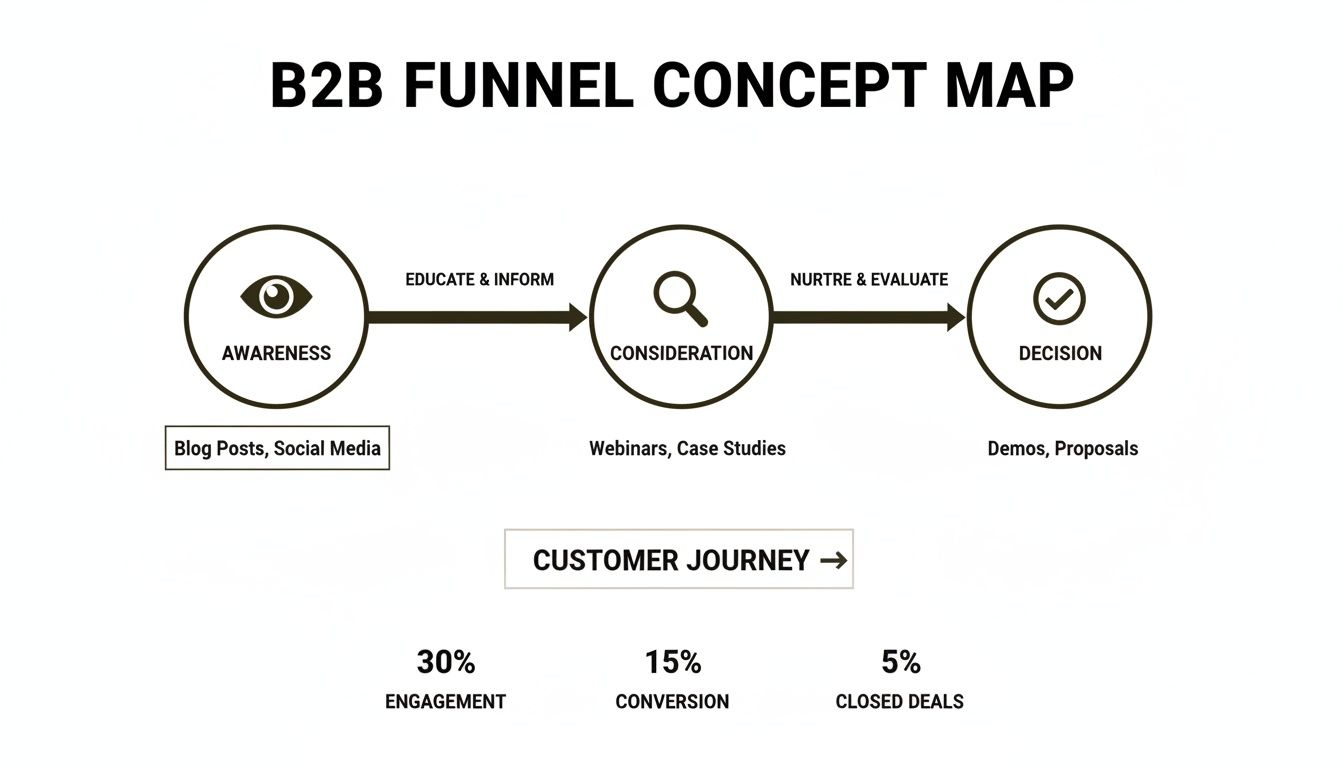
As you can see, the focus shifts from broad, educational content at the top to hyper-specific, solution-focused assets at the bottom. It's a cohesive experience.
The following table provides a high-level overview of how content and channels should adapt as a prospect moves through the funnel.
Content and Channel Strategy by Funnel Stage
Funnel StageContent ExamplesPrimary ChannelsKey Performance Indicators (KPIs)AwarenessBlog posts, whitepapers, industry reports, infographics, educational webinarsOrganic Search (SEO), Social Media, PR, Paid Search (broad keywords)Website Traffic, Keyword Rankings, Social Engagement, New Leads (MQLs)ConsiderationCase studies, comparison guides, product-focused webinars, solution briefs, checklistsEmail Nurturing, Retargeting Ads, Organic Search (solution-aware keywords)Lead Quality, Content Downloads, Demo Requests, Email Open/Click-Through RatesDecisionPricing pages, ROI calculators, free trials, live demos, customer testimonials, implementation guidesDirect Sales Outreach, Email Marketing, Retargeting, High-Intent Paid SearchSales Qualified Leads (SQLs), Conversion Rate (to demo/trial), Sales Cycle Length, Cost Per Acquisition
This strategic alignment ensures you're investing resources where they'll have the most impact, building a predictable pipeline from initial interest to a closed deal.
Fuelling the Top of the Funnel with Educational Content
At the Awareness stage, your entire goal is to attract your ideal customer by being genuinely helpful. These people know they have a problem, but they don't know what the solution is yet. Your content should revolve around their pain points and questions, not your product.
Search engine optimization (SEO) is your best friend here. The data shows that B2B buyers run an average of 12 searches before they even land on a specific brand’s website. By creating top-notch, SEO-driven articles and guides, you can show up in those early searches and pull that qualified traffic into your Webflow site.
Webflow Tutorial: Creating a Lead-Capturing Blog
- Use Webflow CMS: Build your blog using the CMS. Create a "Blog Posts" Collection with fields for the post body (Rich Text), author, categories, and an SEO title and meta description.
- Gate High-Value Content: For a whitepaper or report, create a dedicated landing page. Add a Webflow Form and connect it to your email marketing tool (like Mailchimp or ConvertKit) using native integrations or Zapier. On successful form submission, redirect users to the downloadable asset.
- Optimize for SEO: In the Page Settings for each blog post template, use the dynamic fields you created to automatically populate the title tag and meta description. This ensures every post is optimized for search engines.
Building Trust During the Consideration Stage
Once someone enters the Consideration stage, they’ve put a name to their problem and are now actively shopping for solutions. This is where your content needs to pivot from general education to demonstrating specific value and building rock-solid trust. It's your chance to prove you don't just understand their problem—you have a credible way to solve it.
This stage is all about showcasing your expertise and helping them build the business case for making a change. They’re comparing you to your competitors, so your content must be sharp, specific, and solution-focused.
In the Consideration stage, your content must act as a bridge between the prospect's problem and your solution. It’s not about a hard sell; it’s about providing the evidence-based reassurance they need to move forward with confidence.
Webflow Tutorial: Building a High-Impact Case Study Page
- Create a "Case Studies" CMS Collection: Include fields for the client's logo, a compelling headline, a summary of the challenge, the solution provided, and quantifiable results (e.g., "45% increase in leads").
- Design a Reusable Template: Build a dynamic template page for your Case Studies collection. Use a clear, visual layout that highlights the key metrics and includes a strong client testimonial.
- Add a Relevant CTA: At the end of each case study, embed a call-to-action that's relevant to that specific story. For example, "See how we can get similar results for your SaaS company. Book a consultation." This directs motivated readers to the next logical step.
Closing Deals at the Decision Stage
Down at the bottom of the funnel, prospects are on the verge of a decision. They’ve whittled down their options and are looking for that final piece of validation that you are the right choice. Your content now needs to be direct, persuasive, and laser-focused on knocking down any final barriers to purchase.
Your mission here is to make it incredibly easy for them to say "yes." This means giving them clear, benefit-driven information that arms your sales team and helps your champion sell the idea internally.
Webflow Tutorial: Optimizing Your "Book a Demo" Page
- Embed Your Calendar Directly: Instead of a simple form, use an embeddable tool like Calendly or Hubspot Meetings. In Webflow, drag an "Embed" element onto your page and paste in the tool's code. This allows leads to book a time directly, reducing friction and back-and-forth emails.
- Use Social Proof: Surround the booking widget with trust signals. Add a "Testimonials" CMS Collection and display logos of your best clients or short quotes from satisfied customers near the form.
- Simplify the Form: If you must use a form, keep it brief. Use Webflow's form settings to customize fields, only asking for the absolute essentials (e.g., Name, Work Email, Company Name). Every extra field you add will lower your conversion rate.
Building a High-Converting Funnel in Webflow
Turning your Webflow site into a lead-generation machine isn't about guesswork; it's about building a deliberate, measurable path for your prospects. Let's break down how to lay the groundwork, from tracking user behavior to ensuring your site is lightning-fast. A few smart moves here can dramatically improve the number of qualified leads you hand over to sales.
To learn more about boosting your site's effectiveness, check out our deep dive on conversion rate optimization strategies.
Set Up Analytics to Track the Entire User Journey
You can't fix what you can't see. Before you start tweaking buttons and rewriting copy, you need a clear picture of how people are actually moving through your B2B sales and marketing funnel. This means going beyond simple page-view counts and mapping out the entire customer journey.
Webflow Tutorial: Implementing Analytics
- Add Your GA4 ID: In your Webflow project, go to Project Settings > Integrations. Paste your Google Analytics 4 (GA4) "G-" Measurement ID into the designated field and publish your site. This is your foundation for tracking user behavior.
- Track Form Submissions: To track a "Book a Demo" form as a conversion, give the form element a unique ID in the Webflow Designer (e.g.,
demo-form). Then, set up a Google Tag Manager trigger that fires when a form with this ID is successfully submitted. Link this trigger to a GA4 event tag to record the conversion. - Monitor Key Events: Identify other micro-conversions, like a newsletter signup or a whitepaper download. Create specific events for each in GA4 to see which content pieces are most effective at moving users through the funnel.
Optimize Your Core Web Vitals
Let's be blunt: a slow website is a funnel killer. Busy B2B decision-makers don't have time to wait. A delay of just a couple of seconds can be the difference between a new lead and a bounced visitor who never returns. Performance optimization in Webflow isn't a one-and-done task; it's an ongoing commitment.
Webflow Tutorial: Boosting Site Speed
- Compress Images: Before uploading any image to the Webflow Asset Panel, run it through a free compression tool like TinyPNG. This drastically reduces file size without sacrificing quality.
- Set Image Loading to "Lazy": For images that are below the fold (not visible when the page first loads), select the image in the Designer, go to the Element Settings Panel (D), and choose
Lazyfrom the "Load" dropdown. This prevents them from slowing down the initial page load. - Audit Third-Party Scripts: Go to Project Settings > Custom Code. Review the scripts in your "Footer Code" section. Are you still using all of them? Remove any old or unnecessary tools. For the ones you keep, ensure they are loaded in the footer, not the header, to prevent them from blocking page rendering.
A high-performing Webflow site isn't a luxury; it's a necessity. Faster load times directly correlate with lower bounce rates and higher conversion rates. Think of Core Web Vitals as the welcome mat for your digital storefront—if it’s slow and clunky, your best prospects will turn around and leave.
Mastering the Handoff from Marketing to Sales
Even the most thoughtfully designed B2B sales and marketing funnel can completely fall apart at one critical moment: the handoff. This is where a promising lead, carefully nurtured by your marketing team, gets passed over to sales for a real conversation. If this transition is clunky or misunderstood, all that hard work simply goes down the drain.
The whole thing hinges on everyone agreeing on what makes a lead "good." For this to work, marketing and sales have to be on the exact same page about two terms: the Marketing Qualified Lead (MQL) and the Sales Qualified Lead (SQL). Without a rock-solid definition for both, you’re just inviting chaos.
An MQL is someone who’s been kicking the tires, engaging with your content, but isn't ready for a sales call. They're curious, but they haven't signaled they're ready to buy. An SQL, on the other hand, is someone who has clearly indicated they are actively looking for a solution like yours.
Getting Crystal Clear on MQLs and SQLs
Let’s get practical. An MQL is someone who downloads an educational guide from your Webflow site or signs up for an industry-focused webinar. Their behavior essentially says, “I’m trying to understand my problem better.” They're in the Consideration stage, but they haven't actually raised their hand for help.
An SQL is the person who takes that next step. They request a demo, ask for a pricing sheet, or fill out your "Contact Sales" form. Their actions are unambiguous: “I’m ready to see if your product can fix my problem, right now.” Pestering an MQL with aggressive sales calls is one of the fastest ways to scare them away for good.
The handoff isn't just another step in the process; it's the moment where potential revenue becomes a real opportunity. A seamless transition requires a shared language and an unbreakable pact between your marketing and sales teams.
Creating a Bulletproof Service Level Agreement
To turn this pact into policy, you need a Service Level Agreement (SLA). Think of it as a formal contract that lays out exactly what each team commits to the other. It gets rid of all the guesswork and sets firm, measurable expectations for how every single lead is handled.
Your SLA should spell out, in no uncertain terms:
- The exact definition of an MQL: What combination of actions, job titles, and company details makes a lead qualified for marketing?
- The criteria for an SQL: What specific trigger point tells you an MQL is officially ready to talk to sales?
- Sales follow-up rules: How fast does the sales team have to reach out to a new SQL? A common benchmark is within 24 hours.
- Lead nurturing workflow: What’s the plan for leads who are interesting but not quite ready for a sales conversation?
This agreement transforms the handoff from a casual "toss over the fence" into a structured, accountable process. It makes sure your hottest leads get a call right when their interest is peaking. In a world where B2B sales cycles average 84 days and 75% of buyers are taking longer to make a choice, a quick and persistent follow-up has never been more critical. You can dig deeper into these sales statistics and their impact on your funnel.
How to Measure Your Funnel’s Health with the Right KPIs
You can't fix a leaky funnel with guesswork. Building a high-performing B2B sales and marketing machine is all about the data—specifically, tracking the right numbers to see what’s working and what’s falling flat.
To plug the leaks in your pipeline, you have to look past vanity metrics. The real magic happens when you start measuring the conversion rates between each critical stage of the funnel. This is how you spot exactly where prospects are losing interest and dropping off, turning your analytics from a boring report into a powerful diagnostic tool.
The Conversion Metrics That Actually Matter
Start with these three core conversion rates. Together, they paint a clear picture of your funnel’s overall health and tell you a story about how well your marketing and sales efforts are connecting with buyers.
- Visitor-to-Lead Rate: This is your first handshake. It shows how good your website is at turning anonymous visitors into actual contacts. To find it, just divide your total new leads by your total website visitors.
- Lead-to-MQL Rate: This number tells you all about lead quality. It’s the percentage of those new contacts that are actually a good fit and meet the basic criteria to be considered a Marketing Qualified Lead (MQL).
- MQL-to-SQL Rate: Here’s where the sales and marketing handshake happens. This metric tracks how many of those MQLs your sales team agrees are legitimate, sales-ready opportunities, turning them into Sales Qualified Leads (SQLs).
A low MQL-to-SQL rate is a massive red flag. It almost always means marketing and sales aren't on the same page about what a "good lead" really looks like.
Benchmarking Your Funnel: Are Your Numbers Good or Bad?
Knowing your own metrics is a great start, but the real insights come from comparing them to the rest of the industry. The truth is, most B2B funnels are incredibly leaky. With average conversion rates hovering around a measly 2-5%, most of your hard-earned traffic is slipping through the cracks.
Recent data paints a pretty stark picture: the average visitor-to-lead rate is only about 2.0%. Of those leads, just 31% ever become an MQL. And from there, a tiny 13% make it to the SQL stage. That means over 90% of initial leads disappear before they even have a real conversation with sales. You can dig into the full report and discover more insights about B2B sales conversion rates.
Don't just look at these benchmarks as trivia. They're your guide. Is your visitor-to-lead rate struggling below 1%? It’s time to rethink your website's calls-to-action and content offers. Is your lead-to-MQL rate lagging? You might be attracting the wrong audience with your lead magnets. Using data this way lets you stop guessing and start making smart, targeted fixes that actually drive growth.
Got Questions? Let's Talk Funnel Strategy
Even with the best map, the B2B funnel has its tricky spots. Here are a few common questions we hear from teams trying to smooth out their process.
How Long Should a B2B Sales Cycle Be?
There's no golden rule here. While you might see an industry average of around 84 days, that number can be misleading. A straightforward SaaS subscription could wrap up in a month, while a complex enterprise deal might take the better part of a year.
The real goal isn't to chase some generic industry benchmark. It's about consistently shrinking your own sales cycle. You do that by getting sharper with lead qualification and smarter with how you nurture prospects along the way.
What Is the Biggest Mistake in Funnel Management?
Hands down, it's the classic disconnect between sales and marketing. When these two teams aren't perfectly aligned, everything grinds to a halt. You get endless debates over lead quality, fumbled handoffs, and mixed messages that leave potential customers totally confused.
When you don't have a shared definition of a qualified lead or a clear Service Level Agreement (SLA), leads just fall through the cracks. It's the fastest way to waste marketing dollars and torpedo perfectly good deals right in the middle of the funnel.
How Can I Improve My Funnel on a Small Budget?
Don't chase expensive, flashy tools. Instead, focus on a few high-impact activities that build value over the long haul.
Your best bet? Go all-in on SEO. Start by writing genuinely helpful blog posts that answer the specific, long-tail questions your ideal customers are searching for. This isn't a quick fix; it's about building a powerful asset that pulls in quality organic traffic for years.
On top of that, set up simple email automation to keep nurturing leads without needing a massive software budget. And most importantly, look at what’s already working. If most of your best customers come from referrals, build a simple, formal program to encourage more of them.
Ready to turn your Webflow site into a predictable revenue engine? Block Studio combines expert design, development, SEO, and content creation into a unified growth package. Get in touch to see how we can build your high-converting funnel.