.png)

How to Create Content Strategy That Drives Revenue
Building a solid content strategy isn't just about throwing ideas at the wall and seeing what sticks. It starts with a deep understanding of your business goals and your ideal customer. From there, you dig into keyword and competitor research to find your sweet spot and choose your core content pillars. Only then can you build a production workflow, get the content out there, and track what's actually moving the needle on revenue.
This is how you turn your Webflow site from a static online brochure into a predictable growth engine.
Your Blueprint for a Revenue-Driven Content Strategy
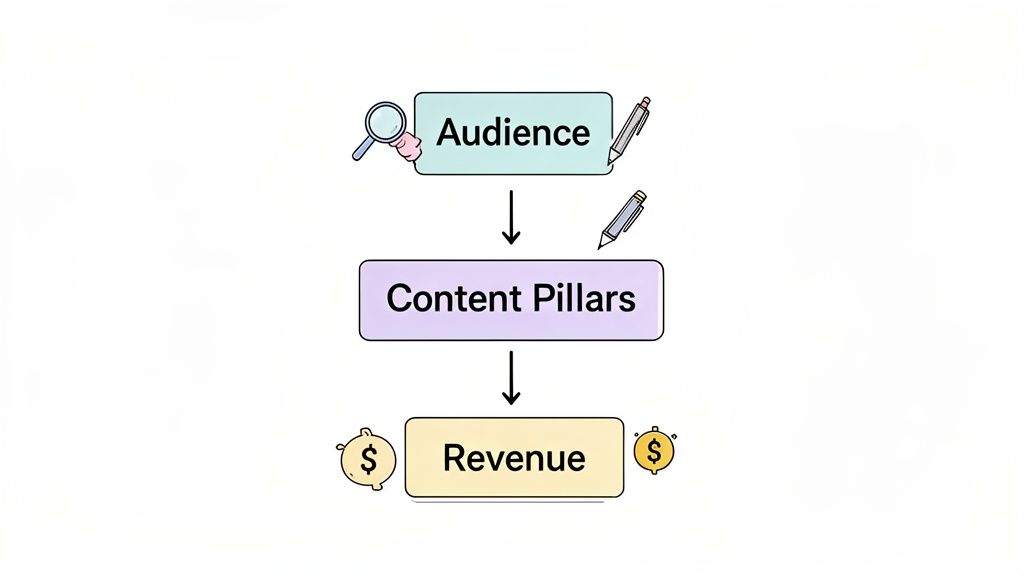
Let's be honest: creating content without a plan is like trying to build a house without a blueprint. It's messy, expensive, and you probably won't like the final result. For any ambitious B2B SaaS company, a scattershot approach is a recipe for wasted time and money. Your goal isn't just to fill a blog; it's to attract the right traffic, generate qualified leads, and prove that content contributes directly to the bottom line.
A revenue-driven content strategy is what connects every article you publish back to a measurable business outcome. It’s a repeatable system that takes the guesswork out of content marketing.
Building a Foundation for Growth
This guide walks you through the exact framework we use to get tangible results for our clients—we're talking 145% lifts in organic traffic. We're moving past vanity metrics to focus on a strategic system built for sustainable growth. The core idea is simple: every single article, guide, and landing page needs to have a specific job to do.
To help you visualize the journey, here’s a quick overview of the key phases involved in building a strategy that actually drives revenue.
The Revenue-Focused Content Strategy Phases
This structured process is the key to turning content into a reliable source of leads and customers.
The industry is taking notice. The global content marketing market is on track to explode from $413.2 billion in 2022 to nearly $2 trillion by 2032. Even more telling, 14% of marketers said content delivered their highest returns in 2023, beating out both paid ads and email marketing. You can dig into more of these content marketing trends to see where things are headed.
A successful content strategy isn't about creating more content; it's about creating the right content with a clear purpose. Each piece should serve as an asset that works for your business long after you hit "publish."
This guide is your tactical playbook for building that library of assets. We'll break down each step with actionable advice tailored for Webflow site owners and B2B SaaS teams ready to finally make content a powerful growth channel.
Laying the Foundation with Deep Customer Discovery
Great content strategy starts with listening, not brainstorming. Seriously. Before you even think about writing a single word, you have to get an almost uncomfortably deep understanding of your business, your ideal customer, and what your competitors are up to.
This initial research is everything. It's the foundation that ensures every article, guide, and case study you create has a real purpose and a clear path to impacting the bottom line. It's not about guessing what might work; it's about systematically gathering intelligence so you know what will work.
The whole process starts internally by getting crystal clear on what the business actually needs to accomplish. Only then do you turn your focus outward to the customer.
Align Content with Revenue Goals
Let's be blunt: a blog that only exists to "have a blog" is a waste of time and money. Your content strategy has to be tied directly to tangible business objectives. You need to draw a straight line from content creation to revenue, whether that means generating more demo requests, boosting trial sign-ups, or arming the sales team with assets that help them close deals.
The best way to do this? Go talk to people. Sit down with the heads of sales, product, and customer success.
Ask them pointed questions that get to the heart of the matter:
- What are the top 3 business goals we absolutely have to hit this quarter?
- What are the most common objections you hear on sales calls? The ones that come up over and over again?
- Where does our product truly shine? What specific pain point do we solve better than anyone else?
- What are the top 5 questions our support team is constantly answering?
The answers you get are a goldmine. A common sales objection can be transformed into a powerful, bottom-of-funnel blog post that crushes that very objection. A frequent support question can inspire a helpful how-to guide that pulls in top-of-funnel traffic from people who don't even know you exist yet.
Build Your Ideal Customer Profile
Okay, you know what the business needs. Now, who are you talking to? This is where your Ideal Customer Profile (ICP) comes in, and it's non-negotiable. An ICP isn't just a semi-fictional persona; it’s a living document that describes the perfect-fit company for your product.
Your ICP is your north star for all content. It tells you who you're writing for, what problems keep them up at night, and—critically—what language they use to talk about those problems. Without it, you're just shouting into the void.
Building a data-driven ICP isn't magic. It's legwork.
- Dig into your sales data. Look at your absolute best customers—the ones with the highest lifetime value and the lowest churn. What do they have in common? Look for patterns in company size, industry, even the tech they use.
- Actually interview your best customers. Pick up the phone or hop on a Zoom call with a handful of your happiest clients. Ask them about their journey. What triggered their search for a solution in the first place? What other options did they look at? What results have they actually seen since signing up?
- Talk to your sales team. Your sales reps are on the front lines every single day. They know the pains, motivations, and daily frustrations of your target audience better than almost anyone in the company.
Mixing this hard data with real human stories helps you get way beyond basic demographics. For a deeper dive into this, check out our guide on how to create buyer personas that genuinely shape your content. This is how you craft stuff that connects on a personal level with the decision-makers at the companies you want to win.
Conduct a Competitive Content Audit
Finally, you have to scope out the competition. A thorough competitive content audit shows you what your rivals are doing well, where they're dropping the ball, and—most importantly—where the content gaps are. These gaps are your opportunities to swoop in, outrank them, and grab valuable market share.
If you’re running a Webflow site, this is pretty straightforward with tools like Ahrefs or Semrush. Start by picking 3-5 of your top organic search competitors. These are the companies that always seem to pop up for the keywords you’re gunning for.
Then, start dissecting their content with a clear plan:
- Find their top pages: Use your SEO tool to see which of their pages get the most organic traffic. This is a cheat sheet showing you exactly what topics are already proven to work for them.
- Run a keyword gap analysis: This is my favorite part. Find the keywords your competitors rank for that you don't. Boom—you now have a direct roadmap for new content ideas.
- Assess their content quality: Now, go read their top-performing articles. Is the information comprehensive and up-to-date? Is the page well-designed and easy to read? Look for weaknesses you can exploit, like outdated stats or a clunky user experience on their Webflow site.
This audit gives you a clear picture of what's resonating in your niche and where you can create content that is 10x better. By combining these three pillars—internal goals, customer research, and competitive analysis—you’re building a rock-solid foundation for a content strategy that’s designed for one thing: growth.
Building Your Content Pillars and Keyword Universe
Alright, you’ve done the hard work. You're now armed with a ton of valuable insight into your business, your ideal customers, and what your competitors are up to. It's time to stop researching and start building—to turn all that intelligence into a concrete plan that will guide every single piece of content you create.
This all starts with defining your content pillars. Think of these as the 3-5 core themes your brand is going to own, period. They are the big, foundational subjects that tie directly back to the problems your product solves and what your audience is desperately trying to figure out. These aren't just blog categories; they're the battlegrounds where you'll establish your expertise.
Defining Your Core Content Pillars
Your content pillars should feel like a natural extension of all that discovery work you just did. They live at the intersection of what your business needs to achieve and what keeps your customers up at night.
Let's imagine you're a B2B SaaS company selling project management software. Your pillars might look something like this:
- Project Management Methodologies: Your go-to source for everything from Agile to Waterfall.
- Team Collaboration & Productivity: Content focused on remote work, efficiency hacks, and team dynamics.
- Software Development Lifecycle: Laser-focused content for your key technical users.
- Resource & Budget Planning: Speaking directly to the operational and financial decision-makers.
Having clear pillars like these brings focus and consistency to your efforts. Every article, guide, or video should tie back to one of these themes, steadily building your topical authority with both Google and your human audience.
Choosing the right pillars isn't about trying to cover everything. It’s about being strategic. Pick the topics where you can genuinely become the undisputed expert, ensuring every new piece of content builds on the last to create an unshakable foundation of authority.
This strategic approach is non-negotiable, especially when you consider that organic search drives an astonishing 93% of website visits. And with 75% of users never venturing past the first page of Google, a scattergun keyword strategy is doomed from the start. It’s no surprise that agencies with a unified SEO and content plan see results like 145% traffic lifts and a 3.2x increase in conversions. A structured plan simply works.
This is where all that initial discovery pays off, as this framework shows.
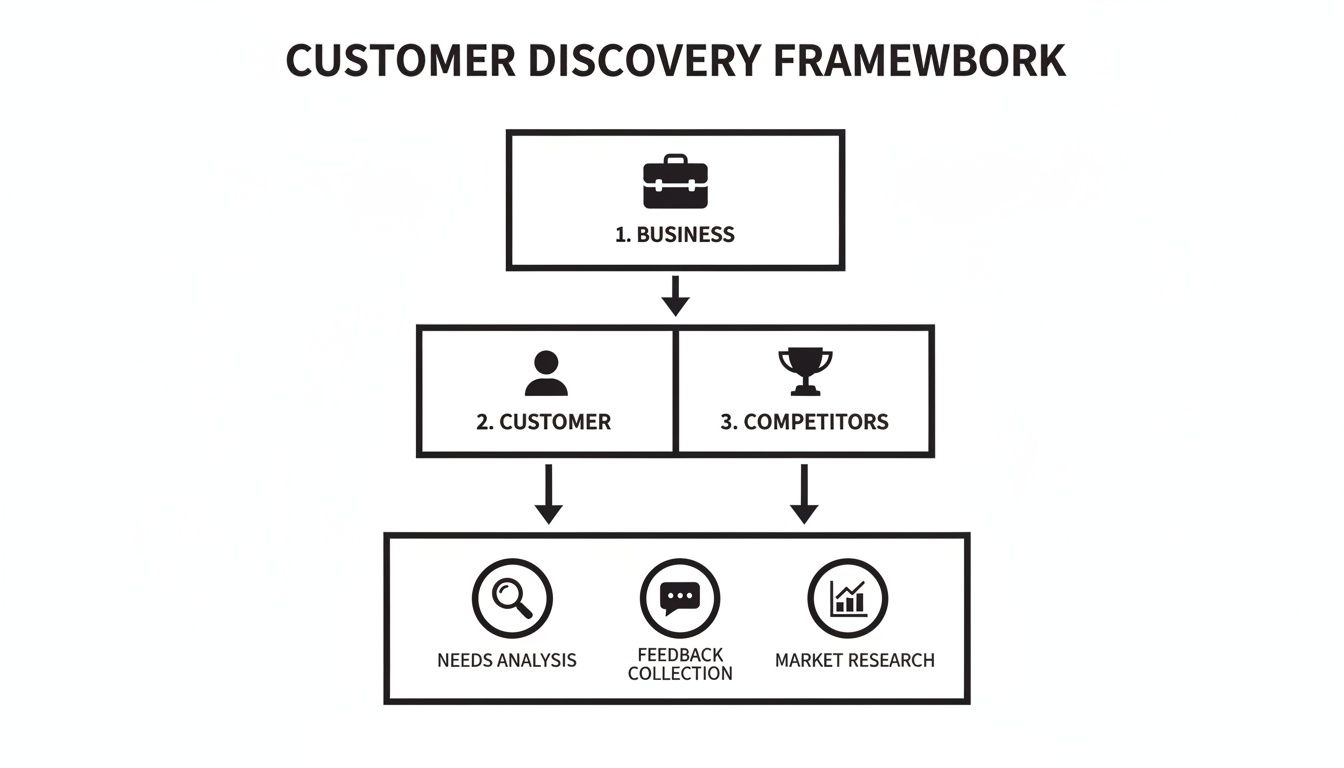
Understanding your business goals, customer needs, and the competitive landscape is the bedrock upon which every successful content decision is made.
From Pillars to a Keyword Universe
With your pillars locked in, it's time to build a keyword universe around each one. This isn't about making a quick list of high-volume terms. It's about meticulously mapping out every question, problem, and query your audience has at every stage of their journey. Your job is to get inside their head and master their search intent.
Think about it. The person searching for "what is agile methodology" is in a completely different headspace than someone searching for "best agile project management software for startups." Your content needs to show up and deliver value for both.
Here’s how to map your keywords to the actual buyer’s journey:
- Top of Funnel (Awareness): This is all about education. People are just starting to identify their problem. Keywords here often look like "what is...," "how to...," or "benefits of...."
- Middle of Funnel (Consideration): Now they're weighing their options. Searches get more specific, like "best tools for...," "[product A] vs [product B]," or "alternatives to...."
- Bottom of Funnel (Decision): They're ready to make a move. These are high-intent, money keywords like "[your brand] pricing," "demo request," or specific service queries like "Webflow development agency."
Building Topic Clusters on Your Webflow Site
This funnel-based keyword mapping flows perfectly into the topic cluster model. A topic cluster is essentially a mini-ecosystem of content on your site. You have a main "pillar page"—a comprehensive, long-form guide on your core topic—that links out to several "cluster content" pages, which are shorter articles that explore specific subtopics in greater detail.
For anyone running a Webflow site, this is an incredibly powerful SEO play.
Let's say you create a massive pillar page on "Webflow SEO Best Practices." You would then link from that page to smaller, more focused posts like "How to Optimize Webflow Page Speed" and "A Guide to Implementing Schema Markup in Webflow."
This structure does two critical things. First, it signals deep expertise to Google, showing them you've covered a topic from every angle. Second, it creates a fantastic user experience, making it easy for visitors to go down the rabbit hole on a subject, which keeps them on your site longer. A big part of this process involves finding what your competitors aren't covering, a process you can learn more about by performing a content gap analysis for SEO.
The final deliverable from this phase should be a detailed content map. This is your master spreadsheet, laying out your pillars, the topic clusters under each, and the specific keywords you're targeting at each stage of the funnel. This isn't just a list of random ideas; it's the strategic roadmap that will fuel your editorial calendar for months.
Building Your Webflow Content Production Engine
A brilliant strategy is just a document until you actually put it into motion. This is where the real work kicks in—turning all that careful research and planning into a steady stream of high-quality content that people actually want to read. The goal is to build a repeatable system, a true content engine, that ensures your strategy doesn't just collect dust but actively drives consistent growth.

If you're running your site on Webflow, you've got a head start. You can build a process that’s not just efficient but also tightly integrated with its powerful, native SEO features. It's time to move away from the chaos of last-minute content creation and into a smooth, predictable workflow that churns out optimized articles, guides, and landing pages like clockwork.
From Briefs to Published Content
The absolute cornerstone of any solid content engine is the content brief. Seriously, don't skip this. A good brief isn't just a list of keywords; it’s the single source of truth for every article. It gets your writers, editors, and designers on the same page from the very beginning, aligning everyone on the goal, audience, and key talking points before a single word is even written.
A strong content brief should always include:
- Target Persona: A quick refresher on who this piece is for.
- Primary & Secondary Keywords: The main search terms we're going after.
- Search Intent: What is the reader trying to do? Learn, compare, or buy?
- Key Questions to Answer: This often forms the outline with H2s and H3s.
- Internal Linking Opportunities: Specific pages on your own site to link back to.
Once you have a solid brief, you need a way to manage the entire workflow. This is where an editorial calendar becomes your best friend. Think of it as your command center, giving you a bird's-eye view of what’s being worked on, what's coming up, and when everything is scheduled to go live. For a practical starting point, check out our editorial calendar template to get a system up and running fast.
Technical SEO and Webflow Best Practices
One of the biggest advantages of Webflow is how it lets you manage technical and on-page SEO without needing to ping a developer for every tiny change. Your production engine absolutely must include a final pre-publish checklist that leverages these built-in features.
This is what makes it so powerful—the ability to control crucial SEO settings right from the editor. Content teams get direct control over how their pages show up in search results and on social media platforms.
Your Webflow pre-publish SEO checklist should cover these essentials:
- Metadata Optimization: In the Page Settings for your CMS item, make sure your Title Tag and Meta Description are compelling, under the character limit, and include your primary keyword.
- Heading Structure: Double-check your Rich Text Editor to ensure you have a logical hierarchy: one H1, followed by H2s and H3s. Don't skip levels.
- Image Alt Text: Click on any image in the Designer or Editor. The Settings panel allows you to easily add descriptive alt text, which is crucial for accessibility and image search.
- Schema Markup: Use the "Custom Code" section in your Page Settings to add JSON-LD schema for articles, FAQs, or events. This helps Google understand your content better and can earn you rich results.
- Page Speed: Use Webflow's built-in asset optimization to automatically compress images. Ensure you're lazy-loading images below the fold to improve initial page load times.
By building these SEO checks directly into your publishing workflow, you ensure no piece of content goes live without being fully optimized to rank. SEO stops being an afterthought and becomes a fundamental part of how you create content.
Using AI to Accelerate Production
Let's be honest: trying to build a content strategy today without AI is putting yourself at a huge disadvantage. Content revenue is projected to jump from $82.3 billion in 2024 to $107.5 billion by 2026, and AI is a massive part of that equation. In fact, 90% of marketers are already planning to use AI, and those who do are reporting 36.2% higher success rates—especially when it comes to ranking and nailing search intent. You can dig into more of these content marketing statistics to see just how much things are changing.
AI tools can seriously speed up your workflow without killing quality. Here's how to use them smartly:
- Research and Outlining: Quickly pull together information and structure an article.
- Drafting: Generate a first pass that your writers can then polish with their own expertise.
- SEO Optimization: Analyze drafts for keyword density and suggest related terms to include.
The trick is to view AI as a collaborator, not a replacement. Let it do the heavy lifting with research and initial drafting. This frees up your human experts to focus on what they do best: adding unique insights, injecting your brand's voice, and providing the strategic value that makes content truly great. This blend of human expertise and AI efficiency is what a modern, scalable content engine is all about.
Measuring Performance and Iterating for Growth
Think of your content strategy as a living, breathing thing—not some dusty document you create once and then file away. To get real growth, you have to constantly check in, measure what's happening, and adjust your plan. Hitting "publish" is just the start. The real work is figuring out what’s connecting with your audience and what's falling flat.
This is how you make sure your efforts compound over time, turning your Webflow site into a machine that consistently brings in new business.
The goal here is to get way past vanity metrics. Sure, page views and social media likes feel good, but for a B2B company, they don't exactly pay the bills. We need to focus on the key performance indicators (KPIs) that actually point to business impact.
Defining KPIs That Actually Matter
If you want to prove your content is worth the investment, you have to track metrics that tie directly to leads and sales. Your measurement setup should be simple, easy to act on, and focused on the bottom line. Don't get lost in a sea of data points; just track the vital few.
For most growth-stage B2B companies, that means zeroing in on these three things:
- Organic Traffic from Non-Branded Keywords: This is your purest measure of SEO success. It tells you how many people are finding you by searching for the problems you solve, not just because they already know your company's name.
- Marketing Qualified Leads (MQLs) from Content: How many people who read your content took the next step? Maybe they downloaded an ebook, signed up for a webinar, or requested a demo. This is the crucial link between your traffic and potential revenue.
- Content-Influenced Revenue: This is the big one. Using your CRM, you can actually see how many closed deals involved a prospect reading a blog post or watching a video at some point. It’s the ultimate proof that your content is helping your sales team win.
A great content strategy is built on a continuous feedback loop. You publish, you measure against real business goals, and you use those insights to make your next piece of content even more effective. Without this loop, you're just guessing.
You don't need a crazy-complex system to track this. A simple dashboard in a shared spreadsheet or a basic report in a tool like Looker Studio can give your team all the visibility it needs to stay focused on what's actually driving results.
Your Measurement Toolkit for Webflow Sites
As a Webflow user, you’ve got some powerful tools right at your fingertips. The trick is knowing what to look for and where. Your go-to toolkit will almost always be Google Analytics 4 (GA4) and Google Search Console.
Inside Google Search Console, you'll want to focus on:
- Performance Report (Queries): Check out the non-branded keywords bringing in the most clicks and impressions. Are they the ones you're actually targeting with your content pillars?
- Performance Report (Pages): Find out which articles are your heavy hitters in organic search. These are your star players—you need to protect them, keep them updated, and link to them often.
Then, over in Google Analytics 4, you'll track:
- Traffic Acquisition: Filter your reports by "Organic Search" to see how much traffic is coming from your SEO efforts. You can compare this to other channels to see how valuable it really is.
- Conversions: This is critical. In Webflow, give your form submission buttons a unique ID. Then, in Google Tag Manager, create a trigger for that button ID and a corresponding tag to fire a GA4 conversion event. This is how you'll measure the MQLs coming from your content.
When you put the insights from both platforms together, you get the full story. Search Console tells you how people are finding you, and GA4 tells you what they do once they land on your site.
Conducting Quarterly Content Audits
For your content to build momentum and deliver compounding returns, you need a system for improving what you’ve already published. A quarterly content audit is the perfect way to do this. The whole point is to find underperforming articles and give them a second chance to shine.
Keep the process simple and repeatable:
- Identify Underperformers: First, pull a list of every blog post published more than six months ago. In a spreadsheet, add their current organic traffic from GA4 and the number of keywords they rank for from an SEO tool like Ahrefs.
- Categorize and Prioritize: Sort that list to find the articles with low traffic but high potential. You're looking for posts that target an important keyword but just aren't ranking where they should be.
- Update and Optimize: For each article you've prioritized, give it a full refresh. Update any outdated stats or information, add new, relevant examples, and fine-tune the on-page SEO directly in the Webflow editor. It's also a great time to build some new internal links pointing to the post.
- Republish and Promote: Finally, change the publish date in Webflow. You can do this by setting a custom "Updated On" date field in your CMS collection. This sends a signal to Google that the content is fresh and relevant again. Then, promote it across your channels just like you would with a brand-new piece of content.
This rinse-and-repeat process of measuring and optimizing is the real secret to long-term content success. It turns every article you create into a lasting asset that keeps bringing in value long after you first hit publish.
Got Questions About Content Strategy? We've Got Answers.
Putting a new content strategy into motion can feel like a massive project, especially when you're already juggling the day-to-day demands of growing a business. We get it. Here are some of the most common questions we hear from B2B SaaS teams and Webflow site owners, along with our straight-up answers.
How Long Until I Actually See Results?
Look, content strategy is a long game, not a get-rich-quick scheme. Think of it as building a valuable asset for your company—it takes time and consistent effort.
Real, meaningful traction in organic traffic and leads usually starts showing up around the 6 to 9-month mark. The first three months are all about laying the groundwork and getting into a publishing rhythm. By months four to six, you should start seeing your target keywords creep up the search rankings. After that six-month point, you can expect to see a real, measurable lift in qualified traffic that isn't just people Googling your brand name.
The secret ingredient is consistency. The results from content marketing compound over time, so sticking with it is everything, even when things feel slow at the start. Every single article you publish adds a little more weight to your site's authority.
What’s the Magic Number for Publishing Posts?
When it comes to content, quality will always trump quantity. Always. That said, a steady publishing schedule is a huge signal to search engines that your site is active, relevant, and an authority worth paying attention to.
For a growth-stage B2B SaaS company, a solid starting point is publishing 1-2 high-quality, long-form articles (think 1,500 words or more) each week. This pace is usually manageable for a small team and is enough to build serious momentum without watering down the quality you need to rank for those competitive keywords. Once you've got your production workflow dialed in, you can think about scaling up—but never, ever at the expense of quality.
How Can I Pull This Off with a Small Budget?
A tight budget just means you have to be smarter and more focused. Don't try to be everything to everyone. Instead, concentrate your firepower where it'll make the biggest dent.
- Go Niche: Zero in on a very specific corner of your industry where you can realistically become the number one expert.
- Hunt for Long-Tail Keywords: These are longer, more specific search phrases. They have lower search volume but much higher intent, meaning the traffic you get is way more qualified and often less competitive to win.
- Create, Don't Advertise (At First): Pour your limited resources into creating one truly exceptional piece of content each week.
- Master Webflow's SEO Tools: Squeeze every last drop of value out of Webflow's powerful built-in SEO features. You can get your on-page optimization perfect without spending a dime on extra tools.
Should I Be Making Videos and Other Stuff, Too?
Yes, eventually. But you have to be smart about how you start. Your blog should be the sun in your content solar system—it's the central hub. Written content is the bedrock of good SEO and the most direct path to building topical authority.
Once you’ve nailed your blog workflow and have some winning articles, then it’s time to get creative. A top-performing blog post is a ready-made script for a YouTube video, a source for a dozen social media graphics, or the data for a killer infographic. The key is to master one format first, then repurpose your winners into new formats based on where your audience actually hangs out online.
Ready to turn your Webflow site into a revenue engine? At Block Studio, we build and execute unified content strategies that combine technical SEO, content production, and conversion optimization to drive compounding growth for ambitious B2B companies. Learn how we can help you grow.