.png)

How to Create Buyer Personas That Actually Grow Your Webflow Site
Creating a solid buyer persona really boils down to one thing: blending real customer data with insights from actual conversations. We're not just sketching out demographics here. The goal is to get inside their heads to understand their ambitions, their biggest headaches, and what finally pushes them to make a purchase.
When you nail this, your persona becomes the strategic compass for everything you build on your Webflow site.
Moving Beyond Generic Personas to Fuel Real Growth
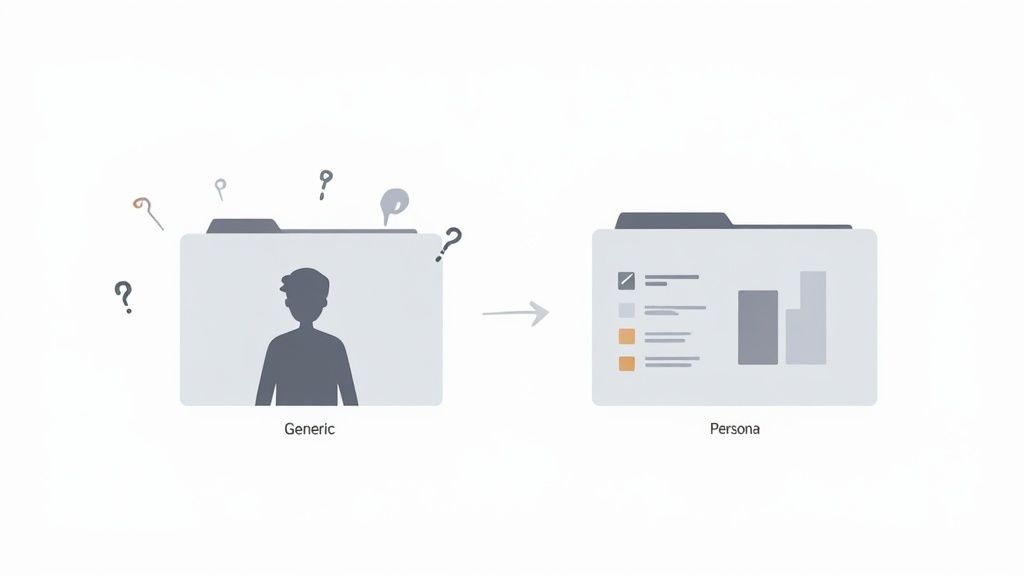
Let's be honest. Most buyer personas are useless. They’re a collection of educated guesses that get filed away and never looked at again. You’ve probably seen them: "Marketing Mary, 35-45, likes coffee and struggles with time management." These vague descriptions are so surface-level they don't help you make a single meaningful decision.
For anyone running a site on Webflow, this is a massive missed opportunity. A deeply researched persona isn't just a marketing exercise; it's the foundation that turns your website from a simple digital brochure into a genuine growth engine.
Why Vague Personas Fail Your Webflow Site
Generic personas fall flat because they lack actionable depth. Knowing your ideal customer’s age or job title doesn't tell you what problem keeps them up at night, or what they're desperately trying to solve when they land on your homepage.
This lack of real insight leads to spray-and-pray marketing and a frustrating user experience. Your content feels generic, your landing pages are built on hunches, and your SEO strategy targets keywords that miss the mark on what people are actually searching for.
I saw this firsthand with a B2B SaaS client. Their original persona, "Startup Steve," was all demographics and assumptions. Their messaging was broad, and their main landing page had a dismal 1.5% conversion rate.
After we pushed them to ditch the guesswork and conduct real interviews, they discovered their best customers weren't just "startup founders." They were technical founders struggling with very specific API integration challenges. That single insight changed everything. They rewrote their copy, tweaked a key section in Webflow to highlight their API documentation, and more than doubled their conversion rate.
This guide is about creating personas like that—the kind that actually get used. We're not making documents destined for a forgotten folder. We're building a tool that connects every piece of your growth strategy.
From Document to Strategic Tool
When done right, a buyer persona is the blueprint for building a real connection with your audience. It gives you the clarity to:
- Design High-Converting Webflow Pages: You'll know exactly what information your persona needs to see, what their biggest hesitations are, and which call-to-action will actually get them to click. You can then use Webflow's visual editor to quickly A/B test different headlines and button copy tailored to specific personas.
- Target Precise Keywords for SEO: Stop guessing what your audience searches for. You'll understand the exact language they use to describe their problems, which brings in much more qualified organic traffic. You can then optimize page titles, meta descriptions, and alt text directly within the Webflow Designer.
- Craft Content That Genuinely Resonates: Your blog posts, case studies, and emails will speak directly to your audience's real pain points and motivations, making them feel understood.
This is how you turn a persona from a static document into an active, strategic asset that guides every single decision you make.
Uncovering Insights Hiding in Your Existing Data
Before you even think about scheduling customer interviews, you’re sitting on a goldmine of insights. The best buyer personas aren't built on guesswork; they start with the data you already have. This is your foundation for forming solid hypotheses about who your customers are and what makes them tick, which makes every conversation you have later on that much more powerful.
Think of yourself as a detective. Your goal isn't just to pull reports but to find the stories hidden in the numbers—the clues about user behavior, their motivations, and the problems they're trying to solve.
Mine Your Webflow Site Analytics
If your site is on Webflow, your first stop should be Google Analytics (GA4). It's packed with information about how people find your site and what they do when they get there. The trick is to ignore the vanity metrics and focus on the data that signals real intent.
Start by looking at the customer journey. Which channels are driving not just traffic, but engaged traffic? I’m talking about people who actually convert or spend a meaningful amount of time on your most important pages. Is it organic search, LinkedIn, or a specific referral partner? This tells you exactly where your future personas are already spending their time online.
Next, dig into your most popular landing pages. Do visitors consistently land on a blog post that solves a very specific, niche problem? Or are they flocking to a feature page that highlights a particular solution? The content drawing the most attention is a massive clue about your audience's biggest pain points. Spotting these patterns can also uncover great ideas for new topics—a process you can refine by doing a full content gap analysis for your SEO strategy.
Decode Your CRM Data
Your CRM is so much more than a sales tool. It's a living library of your most successful customer relationships, and it’s where you can start to connect the dots between the common traits of your best customers.
Filter your contacts down to your most valuable accounts—the ones with the highest lifetime value or the ones who had the smoothest, fastest sales cycles. Now, look for what they have in common:
- Job Titles: Are you always selling to a VP of Marketing, or are you seeing more technical project managers lately?
- Company Size: Do your best customers tend to be at companies with 50 employees or 500?
- Industry: Is there a specific vertical, like FinTech or healthcare, where you're consistently winning?
A quick word of warning here: the insights you get from your CRM are only as reliable as the data inside it. This whole exercise is pretty useless if your data is a mess. As many experts will tell you, mastering CRM hygiene is non-negotiable for pulling trustworthy information to build accurate personas.
These data points help you move from a vague "target audience" to a much sharper Ideal Customer Profile (ICP). The ICP is the company-level profile that comes before you dive into the individual buyer persona.
Observe Real User Behavior on Your Site
Numbers tell you what users are doing, but they rarely explain why. That's where behavior analytics tools like Hotjar or Microsoft Clarity are incredibly useful, especially for dialing in your Webflow site. They give you visual proof of what the user experience is actually like.
Webflow Tutorial: You can easily integrate these tools by pasting their tracking code into your Webflow project settings. Go to Project Settings > Custom Code and paste the script into the "Head Code" section. This will add the tracking to every page of your site.
Use heatmaps to see where people are clicking, moving, and scrolling on your most important pages—like your homepage or pricing page. Are they completely ignoring your main call-to-action button? Are they rage-clicking on an image that isn't actually a link? This is direct feedback showing you where there's confusion or a disconnect.
Session recordings are even better. You can watch anonymous recordings of real people using your site, seeing exactly where they get stuck, hesitate, or get frustrated. For example, you might discover that dozens of users are abandoning your signup form right when they get to a certain field. That’s a clear signal that something about that step is causing friction, and you need to fix it in the Webflow Designer.
By combining analytics, CRM data, and these behavioral insights, you'll build a strong, evidence-based foundation. You won't have the full picture just yet, but you’ll go into the next phase—customer interviews—armed with smart questions and solid hypotheses ready to be validated.
Getting the Real Story with Customer Interviews
If quantitative data is the skeleton of your buyer persona, then interviews are its heart and soul. This is where you move past the numbers and start to understand the real people behind them—their actual motivations, day-to-day frustrations, and ultimate goals.
A great interview isn't just a Q&A session. It's a conversation. It's about getting people to tell you stories. When you can uncover the emotional triggers and pivotal moments that drive their decisions, you’ll find insights that no analytics dashboard could ever give you.
Finding the Right People to Talk To
To get a complete, unbiased picture, you can't just talk to your happiest customers. You need a mix of voices to build a truly representative persona. The goal is to recruit a few people from a few different camps who can shed light on various stages of their journey with you.
Try to interview a handful of people from each of these groups:
- Your Best Customers: These are your power users, the ones who truly get it. They understand the value, use your product to its full potential, and can clearly explain the problem it solved. They show you what success looks like.
- Brand New Customers: The buying process is still fresh in their minds. They can give you a play-by-play of how they evaluated solutions, who else they looked at, and what finally tipped the scales in your favor.
- Customers Who Left (Churned): I know, this one can feel a little awkward, but it's pure gold. Figuring out why someone left exposes friction points, mismatched expectations, or missing features you might not see otherwise. Their story is a roadmap of what to fix.
Asking Questions That Uncover the "Why"
The secret to a killer interview is to ask open-ended questions that spark a story, not a simple "yes" or "no." Stay away from questions that lead them to a specific answer. Instead, your job is to get them talking about their experience in their own words.
The most powerful insights often come from a single, well-phrased question that encourages the customer to reflect on their journey. Your job is to listen more than you talk and gently guide the conversation toward the moments that mattered most.
So, instead of a dead-end question like, "Did you find our platform easy to use?" try rephrasing it to get them to walk you through what happened.
A Few of My Go-To Open-Ended Questions:
- "Take me back to the day you first realized you had a problem with [the challenge you solve]. What was going on?"
- "Before you found us, what were some of the biggest roadblocks or frustrations you were dealing with?"
- "Tell me a bit about your search process. What other tools or solutions did you look at?"
- "Was there a specific 'aha!' moment that made you feel confident this was the right tool for the job?"
- "If you were explaining what we do to a coworker, what would you say?"
This blend of hard data and rich human stories is what makes personas truly effective. You start with the numbers from your CRM and website analytics, but you bring them to life with qualitative insights like these. To see how this comes together, SalesIntel.io has some great examples of how this combination builds effective personas.
Listening for What Really Matters
As you're talking, listen for more than just the words. Pay attention to their tone and the emotional language they use—words like "frustrated," "overwhelmed," "finally," or "relieved." These are breadcrumbs leading you directly to their biggest pain points and the core value they get from your product.
Seriously, write down their exact quotes and the specific phrases they use. This is marketing gold. When you use their own language on your Webflow landing pages, in your ad copy, and as part of your SEO strategy, it creates an immediate connection. People feel like you truly understand them.
Once the interviews are done, it's time to organize what you've learned. The first step is getting everything down on paper. Knowing how to accurately and efficiently transcribe interviews is a game-changer here. A clean transcript makes it so much easier to pull out those killer quotes, spot recurring themes, and start building out the profiles that will guide your entire strategy.
Turning Raw Research into Actionable Persona Profiles
You've done the heavy lifting—you've dug into your analytics and sat down for some incredibly insightful customer interviews. Now you’re staring at a mountain of raw notes, transcripts, and data exports. This is where the real magic happens. It’s time to start connecting the dots and weaving those scattered data points into a clear, cohesive story your entire team can get behind.
Think of this part of the process less like data science and more like detective work. You're looking for patterns, sifting through all the qualitative feedback and quantitative trends to find the common threads that tie different customers together. These shared experiences, goals, and frustrations are the bedrock of your personas.
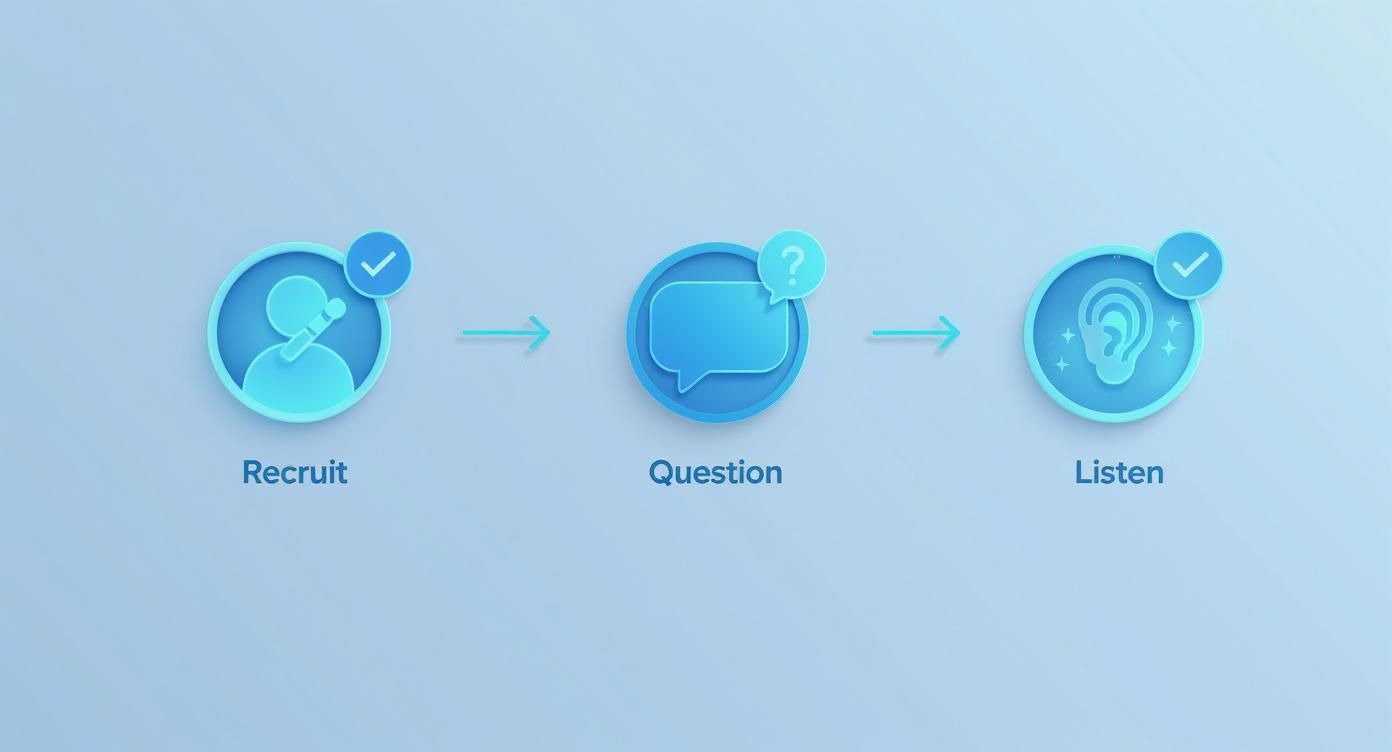
This simple flow—Recruit, Question, and Listen—is the engine that turns abstract data into the relatable, human stories that make for truly authentic buyer personas.
Finding Patterns in the Chaos
Start by just immersing yourself in the interview transcripts. As you read, get your digital highlighter out and mark up compelling quotes, recurring phrases, and moments of high emotion. Look for words like "frustrated," "overwhelmed," or "finally"—these are bright, flashing signs pointing directly to your audience's biggest pain points and motivations.
Next, start clustering what you find. You can use a simple spreadsheet, a tool like Miro, or even just a wall of sticky notes. The tool isn't what's important; the process of grouping similar ideas is.
Look for themes related to:
- Goals & Objectives: What are they actually trying to achieve in their job? Listen for phrases that describe a better future state they're working toward.
- Daily Frustrations: What specific roadblocks keep getting in their way? This is often the spark that ignites their search for a solution.
- Decision Triggers: What was that "I've had enough" moment that sent them looking for a product like yours?
- Success Factors: How do they define a win? What does a successful outcome look like for them, both for their company and their own career?
As you sort through your notes, distinct groups will naturally start to take shape. You might see one cluster of customers totally obsessed with proving ROI to their boss, while another is just desperate to save time on mind-numbing manual tasks. These distinct clusters are your proto-personas, just waiting to be fleshed out.
Building the Persona Narrative
Once you have your key segments identified, it's time to bring them to life with a structured profile. A great persona isn't just a list of facts; it’s a story that makes the audience segment memorable and easy to relate to. For anyone managing a Webflow site, this narrative is what will directly shape your design and content strategy.
The most effective personas feel like real people because they are built from real stories. Give them a name, a stock photo, and a story that captures the patterns you found. This small step transforms an abstract audience segment into a tangible character your team can actually design and write for.
Your persona template needs to be practical, focusing on the information that actually drives action. Ditch the fluff and concentrate on the insights that will guide your marketing, sales, and product decisions.
Key Components of a Persona Template
A truly useful persona goes way beyond basic demographics to get at the why behind a customer's actions. It should be a clear, at-a-glance reference for your team. Here’s a breakdown of what I recommend including:
- Job Responsibilities: What does their day-to-day actually look like? What tasks do they personally own?
- Primary Goals: What are the key metrics or outcomes they're on the hook for?
- Main Challenges: What are the top 1-3 frustrations that keep them from hitting those goals?
- Information Sources: Where do they hang out online to get information? Think industry blogs, specific social media platforms, or Slack communities. This is gold for understanding what is search intent and knowing where to place your content.
- "A Day in the Life" Narrative: A quick paragraph that tells their story, making the persona feel more human and memorable.
- Direct Quotes: Pull 2-3 powerful quotes straight from your interviews that perfectly capture their voice and core struggles.
To make this tangible, let's map out how your research fuels each part of the persona.
Mapping Data Sources to Persona Components
This table shows exactly how each piece of data you collected has a home and a purpose in building out a complete, actionable profile.
Let’s see it in action. After interviewing several customer support managers for a SaaS help desk tool, a clear persona begins to form. We'll call her "Support Team Lead Sarah."
Example Persona: Support Team Lead Sarah
- Job: Manages a team of 8 support agents at a mid-sized B2B tech company. Her day is a blur of meetings, analyzing support tickets in Zendesk, and coaching her team.
- Goals: Reduce ticket resolution time by 20% this quarter; improve the team's CSAT (Customer Satisfaction) score to 95%.
- Challenges: Her team is swamped with repetitive, low-level questions, and she spends hours manually pulling data to create performance reports for her director. She feels constantly stuck in reactive mode.
- Quote: "I feel like I spend my entire day putting out fires instead of proactively helping my team grow. We’re just treading water."
This brief profile instantly gives your team a crystal-clear picture of who they're serving. She's not just a generic "support manager"; it's Sarah, who is stressed about manual reporting and desperately needs a way to get her team working on higher-value problems. This is how you turn a pile of raw data into your most powerful strategic tool.
Putting Your Personas to Work on Your Webflow Site
Creating your buyer personas is a huge milestone, but their real value isn't in the document itself—it's in the application. A persona that doesn't directly influence your strategy is just a nice-to-have. Now, we'll translate your research into concrete actions within your Webflow site and across your marketing channels, turning those profiles into a true engine for growth.
This is where your deep understanding of your customer’s goals and frustrations pays off. You'll move from making broad assumptions about your website to making precise, persona-driven decisions that lead to higher engagement, better leads, and more conversions.
Map Personas to the User Journey
Each persona you’ve built will interact with your Webflow site differently. Why? Because they have unique goals and are at different stages of awareness. Your first step is to map their likely path. For example, "Support Team Lead Sarah" might be in problem-discovery mode, so her journey probably starts with a Google search for a specific pain point.
In contrast, a more senior persona like "VP of Operations Victor" might already be solution-aware and land directly on your pricing or features page from a referral. Understanding these distinct pathways is the key to tailoring the experience on your most important pages.
For Sarah, your blog posts and top-of-funnel content need to speak directly to her daily frustrations. For Victor, your landing pages must immediately address ROI and integration concerns. This means customizing headlines, hero copy, and social proof on your Webflow pages to align with what each persona needs to see at that exact moment.
Build Persona-Driven Content and SEO Strategies
Your personas are your ultimate guide for content creation and SEO. You no longer have to guess what topics will resonate or which keywords to target. You can pull the exact language and questions from your interview notes to build a content strategy that serves each persona.
Webflow Tutorial: Once you identify a persona’s pain points, create a dedicated blog category in the Webflow CMS for each persona. This organizes your content and makes it easy for users to find relevant articles. For example, create a "Support Leadership" category for Sarah and an "Operations ROI" category for Victor.
Think about organizing your content into clusters that address your persona’s core problems:
- Problem-Awareness Content: Create blog posts and guides that answer the specific questions "Support Team Lead Sarah" is typing into Google, like "how to reduce support ticket volume." This is foundational for capturing early-stage interest.
- Solution-Evaluation Content: Develop comparison pages, case studies, and feature deep-dives for personas who are actively evaluating options. This content helps them justify a decision.
- Decision-Making Content: Craft ROI calculators, security documents, and implementation guides for senior personas like "VP of Operations Victor" who need to de-risk the purchase.
This content strategy directly fuels your SEO efforts. By targeting the specific search terms each persona uses, you attract more qualified visitors. For a deeper dive, check out our guide on how to increase organic traffic by aligning your content with user intent.
Personalize Marketing and Email Campaigns
Generic email blasts just don't cut it anymore. With clearly defined personas, you can segment your audience for hyper-relevant communication that actually gets opened and clicked. Segmenting your email list by persona is one of the most powerful ways to put your research into action.
The impact of this approach is significant. According to one study, email campaigns tailored using buyer personas can increase open rates by two to five times. This is because the content speaks directly to the recipient's specific challenges and goals, cutting through the noise of a crowded inbox and building a stronger connection. You can discover more insights about these findings on salesgenie.com.
Webflow Tutorial: Your Webflow forms are a powerful tool for this. Add a simple dropdown field like "What best describes your role?" to your lead capture forms. In the Form Settings, give this field a unique Name (e.g., "persona-role"). This data can be passed to your email marketing tool or CRM, allowing new leads to self-segment and automatically placing them into the correct persona-based email nurture sequence.
By activating your personas in this way, you create a cohesive and personalized experience across your entire digital presence. Every touchpoint—from the initial Google search to the final thank you page on your Webflow site—is designed to meet the specific needs of your ideal customer, turning your hard-earned research into measurable business results.
A Few Common Questions About Building Buyer Personas
Even with a solid playbook, a few practical questions always pop up when teams dive into building personas. Getting these details right is the difference between personas that work and personas that get ignored.
Let's walk through the three questions I hear most often.
How Many Buyer Personas Should We Actually Create?
This is the classic "quality over quantity" debate. It’s tempting to map out every possible customer segment, but this almost always backfires. You end up with either a dozen vague profiles that are too broad to be useful or so many that your team can't keep them straight. It's a fast track to analysis paralysis.
For most B2B SaaS companies I've worked with, the sweet spot is between three and five core personas. This range is tight enough to let you go deep on each one, yet broad enough to cover your most important market segments.
My advice? Start with your absolute best customer segment first. Build one incredibly detailed, data-backed persona before you even think about the next one. It’s far better to have one persona your team lives and breathes than five that just collect digital dust.
How Often Should We Update These Things?
Buyer personas are not "set it and forget it" documents. They're living profiles of real people, and people change. Markets shift. An outdated persona can be just as damaging as a poorly researched one.
You don't need to start from scratch every quarter, but you do need a plan.
I recommend a formal review and refresh of your personas at least once a year. That said, certain events should trigger an immediate review:
- Entering a new market: A new industry or geographic region brings a whole new set of challenges and motivations you need to understand.
- A big product shift: If you launch a major new feature or your core value prop changes, you might start attracting a totally different buyer.
- Buying behavior changes: Is the sales team suddenly hearing new objections? Are you seeing a weird new user journey in your analytics? Time to dig in and see what's changed.
Wait, What's the Difference Between a Buyer Persona and an ICP?
This is a big one, and the confusion is understandable. The terms are related, and you absolutely need both, but they serve very different purposes. I like to think of it as the "what" versus the "who."
An Ideal Customer Profile (ICP) defines the company you're targeting. It’s a description of the perfect-fit account, based on firmographic data like:
- Industry or vertical (e.g., FinTech, Healthcare)
- Company size (50-500 employees, $10M+ ARR)
- Geographic location
- Specific technologies they use (like Salesforce or HubSpot)
A Buyer Persona, on the other hand, describes the individual people inside those ideal companies—the ones who actually make the buying decision. The persona is a human-centric profile that gets into their personal goals, day-to-day frustrations, job titles, and what motivates them.
For instance, your ICP might be "US-based SaaS companies with 50-200 employees." But within that company, you’ll be talking to very different people, like "Support Team Lead Sarah" and "VP of Operations Victor." You need the ICP to find the right companies, but you need the personas to craft a message that actually connects with the real humans you're trying to reach.
At Block Studio, we don't just build websites; we build growth engines. We turn deep audience insights, like the ones you get from powerful buyer personas, into high-converting Webflow sites and SEO strategies that deliver real results. See how our unified approach can transform your online growth.