.png)


In-House vs Agency Marketing for Webflow Companies
For companies scaling up on Webflow, the "in-house vs. agency" question isn't just a line item—it's a defining fork in the road. You're balancing the deep, intrinsic knowledge of a dedicated internal team against the immediate firepower and specialized skills an agency brings to the table. One offers unmatched brand immersion; the other provides a pre-built engine ready to drive revenue.
The Growth Dilemma: In-House vs. Agency Marketing
Every ambitious team wants to turn their Webflow site into a revenue machine. The real question isn't if you should invest in marketing, but how. Deciding whether to build your own team from the ground up or partner with an agency is one of the most significant choices you'll make, shaping your budget, momentum, and overall strategy. There's no single right answer for everyone, but there's definitely a right answer for you.
At its core, this choice is a game of trade-offs. Are you aiming for a team that lives and breathes your brand exclusively? Or do you need a full suite of specialized skills ready to go from day one? Is your top priority having total control over every single detail, or is hitting your next growth target with speed the most critical mission?
Core Trade-Offs At a Glance
Let's break down the fundamental differences to frame this decision. Each path has its own set of pros and cons that click with different business goals and internal capabilities. Getting a handle on these trade-offs is the first real step toward making a smart choice for your Webflow site's future.
This table gets right to the heart of the matter. It shows how each option forces you to prioritize one benefit over another.
The core dilemma is clear: an in-house team offers deep brand immersion at the cost of speed and specialized breadth, while an agency delivers immediate, specialized impact at the cost of direct daily control.
Ultimately, the right path hinges on your company's stage, available resources, and how fast you need to grow. A startup with a long runway might choose to invest in building an in-house team as a core asset. On the other hand, a scale-up that needs to hit demanding quarterly targets or quickly dominate a new market will find an agency's instant expertise to be a game-changer. This guide will dig into these scenarios, helping you decide which model truly supports your ambition to make your Webflow site a powerhouse for growth.
A Nuanced Look at Costs and ROI
When you're weighing an in-house team against an agency, the conversation almost always kicks off with cost. But just looking at salary is like seeing only the tip of the iceberg. The real financial picture for an in-house team is its total cost of ownership (TCO), and it goes way beyond a monthly paycheck. It’s a major fixed investment loaded with hidden expenses.
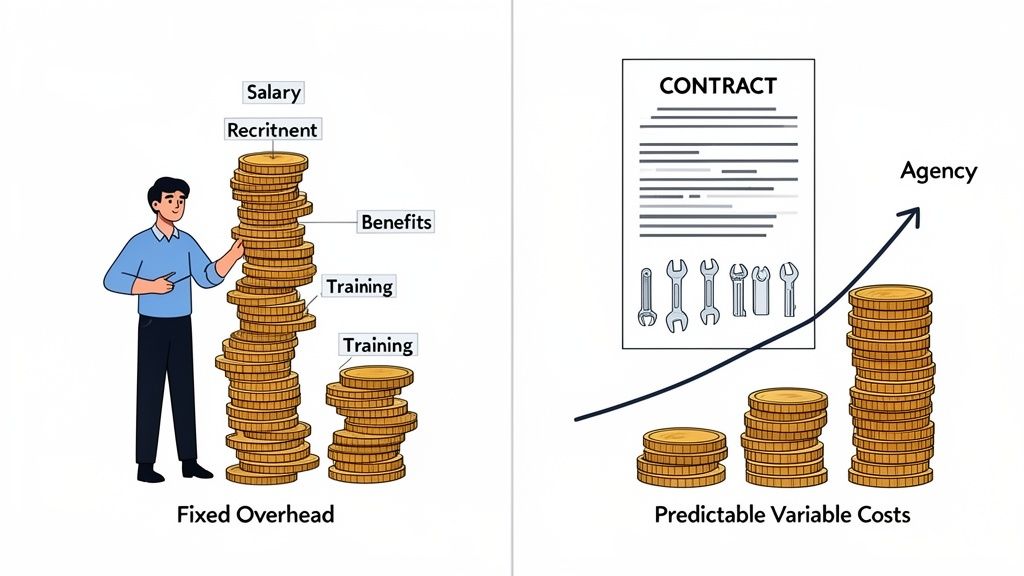
An agency, on the other hand, works on a variable cost model. You get a predictable monthly retainer that covers all the expertise, tools, and execution you need, but without the long-term financial weight of full-time employees. This makes budgeting so much cleaner and more scalable, which is a lifesaver for growth-stage companies where cash flow is everything.
The Hidden Costs of an In-House Team
Bringing a marketer in-house involves a lot more than just their base salary. You have to factor in all these other expenses, which can easily tack on an extra 30-40% or more to the TCO:
- Recruitment and Onboarding: Whether it's recruiter fees or the time your team spends sourcing and interviewing, hiring costs thousands of dollars before anyone even starts.
- Benefits and Taxes: Think health insurance, retirement plans, and payroll taxes. These are serious, recurring costs.
- Software and Tools: A solid marketing stack for SEO, analytics, and content isn't cheap. It can easily run over $1,000 per month for a small team.
- Training and Development: To keep your team sharp, you need to invest in their education—courses, conferences, and certifications all add up.
An agency takes all of this overhead off your plate. Their retainer includes access to enterprise-grade platforms for SEO research, analytics, and Webflow optimization. These are tools that are often just too expensive for a single company to license on its own, so you get the benefit without the direct hit. Of course, both teams can use modern tools to work smarter; looking into the best AI content creation tools can really move the needle on output and affect your overall ROI.
Agency Model: The Path to Faster ROI
A new in-house hire will likely spend their first few months just getting their bearings. In contrast, a good agency is built to start delivering from day one. That speed is a massive factor when you’re calculating Return on Investment (ROI). If you’ve got quarterly targets to hit or another funding round to secure, that six-month ramp-up period for a new employee represents a huge opportunity cost.
An agency’s value isn’t just in the work they do, but in the speed at which they do it. By compressing the timeline from strategy to results, they can generate a positive ROI much faster than a newly formed internal team.
Let's break it down. A $7,000 per month agency retainer might seem like it’s in the same ballpark as a single marketer's salary. But that retainer doesn't just get you one person—it gets you immediate access to a strategist, a content lead, an SEO specialist, and a Webflow developer. Try to build that team yourself, and you're looking at over $250,000 per year in salaries alone, and that's before all the overhead we just talked about.
With an agency, you can deploy a complete, multi-skilled marketing team for a fraction of the cost and in a fraction of the time. It’s a powerful way to get rapid, measurable growth, turning your marketing budget from a fixed operational cost into a predictable revenue driver.
Comparing Expertise and Speed to Impact
When you're a scaling business, every decision gets measured by its impact on momentum. The classic debate between hiring in-house or partnering with an agency really comes down to a crucial trade-off: do you invest the time to build a team that lives and breathes your culture, or do you deploy a specialized team that can deliver results right now?
It's the difference between slow cultivation and rapid execution.
An in-house team is an investment in deep, long-term brand knowledge. Over many months, they become fluent in your product’s smallest details, your company’s unique voice, and the unwritten rules of your culture. That total immersion is fantastic for brand consistency and making sure every marketing move feels authentic.

But let's be honest—this process is anything but fast. Assembling a truly well-rounded team with specialists in technical SEO, Webflow development, and content strategy can easily burn through six months to a year. You're sinking major resources into sourcing, interviewing, hiring, and onboarding each person, all of which delays any real impact.
Deploying a Ready-Made Team of Specialists
An agency completely flips that timeline on its head. Instead of a drawn-out hiring cycle, you get a vetted, multi-disciplinary team ready to get to work within weeks. They arrive with a proven toolkit of processes, strategies, and hard-won experience from solving the exact same problems for other companies. This "plug-and-play" capability is a massive advantage for any scale-up that needs to show results, fast.
For Webflow site owners, this is especially critical. Here’s a quick tutorial on how an agency can solve a common Webflow SEO problem faster than an in-house generalist:
Problem: Your blog posts have inconsistent H1/H2 structures, hurting your keyword rankings.
Agency Solution (Tutorial):
- Audit with Semrush/Ahrefs: The agency's SEO specialist runs a site audit to identify all pages with missing or multiple H1 tags.
- Standardize in Webflow Designer: The Webflow developer on the agency team goes into the CMS Collection Page settings for your blog.
- Set the Rule: They ensure the "Post Title" field is definitively mapped to the H1 tag and that no other elements on the template are mistakenly set as an H1.
- Bulk Republish: After saving the template, they republish all affected items, fixing the issue across your entire blog in minutes.This is a task that could take an in-house marketer hours of manual checking, whereas a specialized team solves it at the source.
The core difference is this: an in-house team learns on your time and your dime. An agency brings expertise learned on someone else's, allowing them to deliver solutions, not just start the learning process.
This accelerated timeline is a direct path to a faster ROI. While your new internal team is still getting their bearings, an agency is already launching campaigns, driving leads, and delivering the measurable outcomes that actually fuel growth.
Agency Operations Are Built for Speed
This kind of efficiency is by design. Agencies are built to counter the slower, fixed-cost structure of in-house teams with operational agility. By 2025, over 51% of marketing agencies plan to employ dedicated operations leads just to streamline client delivery. They also use variable pricing to slash costs by up to 40% for burst campaigns, giving you access to enterprise-level tools for things like AI-driven bidding and analytics that a small internal team just can't afford.
Block Studio’s model is a perfect example of this. Our Pro plans give you a strategist, editor, designer, and developer with a 2-3 week onboarding. We often see significant conversion gains for clients without them ever needing to build an internal army.
This operational focus allows an agency to be a true growth partner. We don't just check tasks off a list; we bring a structured approach that speeds up everything from content production to technical fixes. You can check out our guide on building an effective marketing team structure to see how these specialized roles create a high-velocity engine.
Real-World Impact on Your Timeline
Let’s map this to a tangible goal: launching a content program to drive qualified leads.
- In-House Approach: You need a content strategist, an SEO specialist, writers, and an editor. The hiring process alone could take 3-4 months. After they’re onboarded, you’ll spend another 2-3 months just developing a strategy and producing the first few pieces of content. Realistically, you’re looking at six months before you see any meaningful traffic.
- Agency Approach: You sign with an agency. Within two weeks, they've completed onboarding and presented a full content and keyword strategy. By week four, the first optimized articles are live on your Webflow site. You start seeing measurable traffic gains within the first quarter.
For a business laser-focused on growth, that six-month head start is everything. An agency's specialized expertise doesn't just offer a different way to do marketing—it provides a faster, more direct path to hitting your business goals.
Striking the Balance: Strategic Control vs. Fresh Perspective
One of the biggest draws of building a marketing team in-house is the allure of absolute control. When your team is just down the hall, you get direct oversight of everything—from daily tasks and brand messaging to the long-term strategic vision. This proximity is great for ensuring everyone lives and breathes your company culture and product.
But that closeness can also be a double-edged sword. Insulated teams often fall victim to internal biases, creative ruts, and an unspoken resistance to challenging the status quo. Good ideas can get lost in groupthink, and flawed strategies might persist just because "that's how we've always done it."
This is where an agency partner brings something invaluable to the table: an outside perspective. They aren’t tangled up in your company’s internal politics or history, which means they can give you an honest, objective take on what’s working and what’s not. That fresh look is often exactly what’s needed to break through a growth plateau.
Redefining Control for Modern Partnerships
The old-school view of agencies—where you just hand over the keys and hope for the best—is completely outdated. A modern partnership isn't about top-down command; it’s about collaborative alignment. You maintain strategic oversight while trusting specialists to do what they do best.
This is all made possible with structured, transparent systems that keep everyone on the same page:
- Shared Communication Channels: Dedicated Slack channels are a game-changer. Instead of waiting a week for a check-in call, you have a direct, real-time line to your agency team for quick questions and updates.
- Transparent Reporting Dashboards: Live dashboards give you a clear, unfiltered view of performance against the metrics that matter. This data-driven approach means decisions are based on results, not just gut feelings.
- Collaborative Strategy Sessions: Regular strategy meetings ensure the agency’s day-to-day execution is always tied to your core business goals. It allows for quick pivots as market conditions shift.
With these systems in place, you never feel out of the loop. You get full visibility and strategic input without having to micromanage every single task.
The goal isn't to give up control, but to evolve it. A true partnership shifts the focus from managing tasks to aligning on outcomes, where the agency’s success is directly tied to your business growth.
The Power of an Objective Lens
An external partner does more than just tick boxes on a to-do list. They bring a wealth of experience from working across dozens of other companies, allowing them to introduce proven frameworks and challenge the internal assumptions that might be holding you back.
Actionable Tip for Webflow Owners: Ask a potential agency partner to do a quick 15-minute audit of your Webflow site during the sales call. Ask them to identify one technical SEO issue and one conversion rate optimization (CRO) opportunity they see immediately. A good partner will be able to spot things like poor mobile navigation structure or an ineffective call-to-action (CTA) in the Webflow Designer on the fly. This not only showcases their expertise but also gives you immediate, valuable feedback.
This objective feedback loop is crucial for real, continuous improvement. When you blend your team's deep brand knowledge with an agency's broad market expertise, you create an incredibly powerful dynamic. You get the best of both worlds: the consistency of an internal team and the innovative thinking of an external expert. It’s a model that keeps your marketing from ever going stale.
Finding Your Scaling Sweet Spot: The Hybrid Model
Growth is never a smooth, predictable ramp. It's lumpy. It comes in waves, driven by market shifts, product launches, and unexpected opportunities. Your marketing resources need to be just as nimble.
While building an in-house team is a fantastic long-term goal, scaling that team up or down is slow, expensive, and often brutal. Layoffs destroy morale, and rapid hiring cycles are a massive drain on time and focus. This is where an agency’s flexibility really shines. Need to flood the market with content for a major launch? An agency can scale up with you. Need to tighten the belt during a slower quarter? You can adjust the retainer. This kind of agility is invaluable for managing cash flow and jumping on opportunities the moment they appear.
The Best of Both Worlds: A Hybrid Approach
For most ambitious companies on Webflow, the answer isn't a hard "either/or" choice. The most effective and scalable structure we've seen is the hybrid model. It strikes the perfect balance between internal ownership and external expertise, creating a powerful growth engine without the massive overhead.
Here’s what that typically looks like in practice:
- A Core In-House Lead: You bring on a Marketing Director or Head of Growth. This person owns the high-level strategy, is the guardian of the brand, and lives and breathes your business goals.
- A Specialized Agency for Execution: This internal leader then manages a specialist agency partner (like Block Studio) to handle the day-to-day tactical work. The agency becomes a true extension of your team, executing on content production, technical SEO, Webflow development, and campaign management.
This setup frees your internal leader to focus on big-picture strategy and aligning marketing with sales and product, instead of getting buried in content calendars and keyword research.
Why the Hybrid Model Is a Game-Changer for Webflow Teams
This model is particularly potent for companies built on Webflow because it pairs deep strategic control with scalable, expert execution. You get the irreplaceable internal knowledge from your marketing lead, combined with an agency's ability to execute ambitious, specialized projects.
Think about what this unlocks. You could launch a sophisticated Webflow SEO program or ramp up content from two to ten articles a month—all without having to hire, train, and manage a single new employee.
A hybrid model turns your marketing department from a fixed operational cost into a dynamic, scalable asset. You get the strategic command of an in-house team with the on-demand expertise and pure efficiency of an agency.
This isn't just a hunch; the data backs it up. A 2024 report from HubSpot found that 64% of companies feel agencies offer better access to specialized skills than they can find in-house. The report specifically points to the rise of hybrid models as the go-to strategy for maximum scalability. Ambitious companies are clearly choosing this path to turn their websites into reliable revenue engines without the constant friction of hiring.
Streamlining Execution with a Unified Partner
The magic of the hybrid model is amplified when your in-house lead partners with a single, unified agency. Instead of juggling a separate SEO firm, a freelance writer, and a Webflow developer, one partner streamlines everything. Communication is simpler, and you can be sure all your marketing efforts are pulling in the same direction.
A well-defined partnership also creates incredibly efficient processes. For example, you can build a seamless content production workflow that perfectly integrates your internal strategy with an agency's execution engine. At the end of the day, this approach lets you scale your marketing intelligently, matching your investment directly to your growth.
A Practical Framework for Making Your Decision
The in-house vs. agency debate isn't about which is "better" in a vacuum. It’s about which model is right for your company, right now. Making the right call means taking a hard, honest look at your goals, resources, and timeline. This framework is designed to help you do just that.
Think of it as a series of gut-check questions. The answers will point you toward the right operational model to make your Webflow site a real growth engine.
What Are Your Core Business Objectives?
First things first, what does success look like and how fast do you need to get there? Are you staring down a quarterly sales target or a funding round that demands a sharp increase in qualified leads in the next six months? If speed is the name of the game, an agency is almost always the answer. They can spin up a full team and get to work in weeks, not months.
On the other hand, if you're playing the long game—building a deeply embedded brand identity over several years—then grooming an in-house team makes more sense. You'll sacrifice initial speed for deep brand immersion and long-term consistency.
The decision often boils down to this: Urgency favors an agency, while a long-term, foundational brand-building effort can justify the time it takes to hire in-house. Align your choice with your most pressing business milestones.
This decision tree gives you a visual map of the trade-offs. You can see how the slow-and-steady in-house approach compares to the fast-and-flexible agency route.
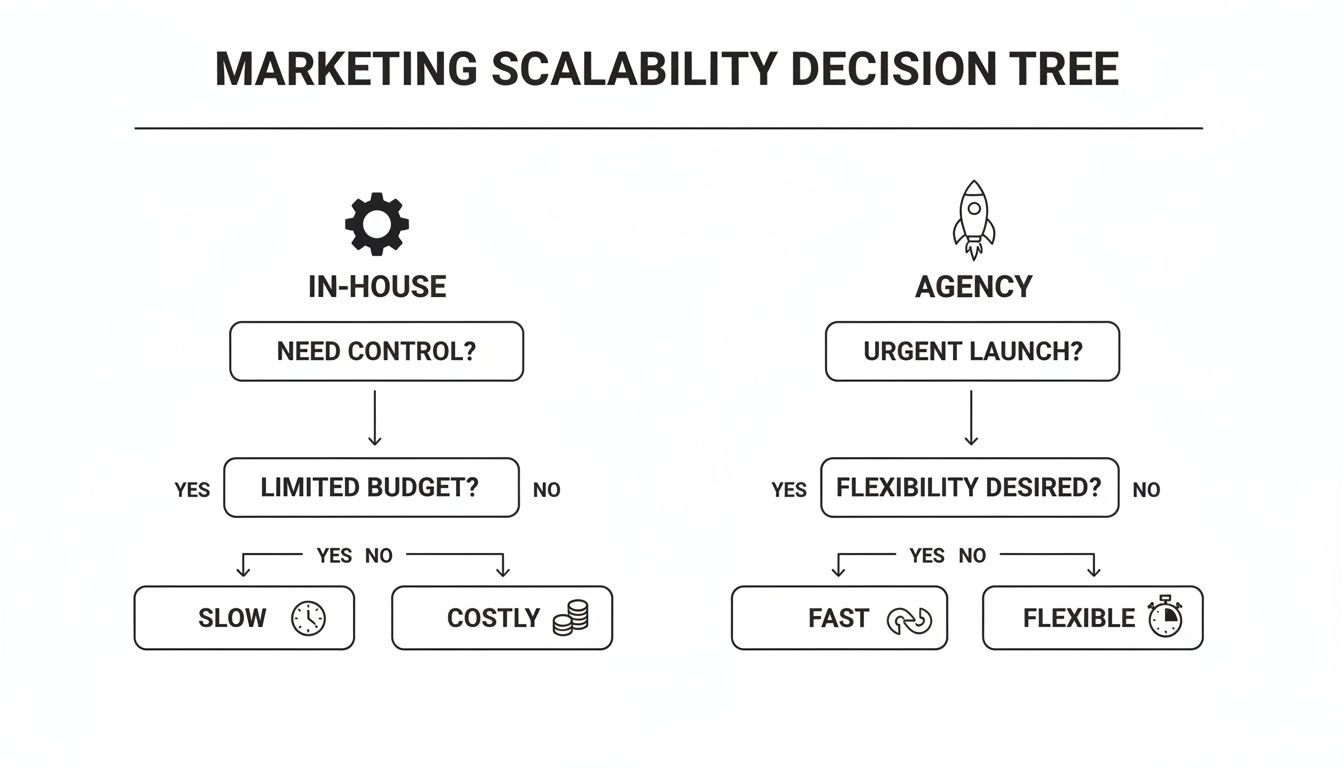
It’s clear that for any company that needs to grow and adapt quickly, an agency partnership provides the horsepower.
What Resources and Complexity Are You Dealing With?
Next, be realistic about your internal capacity and budget. Do you just have a salary in mind, or have you accounted for benefits, recruiter fees, training, and the hefty software licenses a modern marketing team needs? When you add it all up, an agency's predictable retainer often looks much more manageable than the true, fully-loaded cost of an employee.
Also, think about the technical side of things. If your strategy hinges on complex Webflow development, deep technical SEO, and sophisticated multi-channel analytics, finding that talent is tough. An agency gives you instant access to specialists you couldn’t possibly hire and train yourself without a massive investment of time and money. For a closer look at this particular piece of the puzzle, our guide on when to outsource your web development is a great resource.
How To Prepare to Work With an Agency
If the signs are pointing toward an agency, the work begins before you even sign a contract. A little prep work goes a long way in ensuring the partnership is a success from the get-go.
Here’s a quick tutorial for Webflow site owners on prepping for an agency partnership:
- Grant Read-Only Access: Before the kickoff call, invite your agency to your Webflow project with "Can view" permissions. This lets them explore your site structure, CMS collections, and custom code without being able to make changes.
- Define Your CMS: Document how your key CMS Collections (e.g., Blog Posts, Case Studies, Team Members) are structured. A simple list of collection fields and their purpose can save hours of discovery time.
- Audit Your Tech Stack: Make a list of every tool in your stack—from Google Analytics and your CRM to any custom integrations—and be ready to grant access. Nothing kills momentum like waiting a week for a login.
As you consider your options, checking out different perspectives on what the best SEO consultant services look like can help you zero in on what makes a great external partner. By doing your homework, you set the stage for your agency to hit the ground running and start delivering value immediately.
Decision Checklist: In-House or Agency?
Still on the fence? Run through this checklist. It’s designed to help you weigh the factors most relevant to your business and see which way the scale tips.
This isn't about getting a perfect score. It's about seeing the pattern. If your answers lean heavily to one side, you probably have a clear direction forward.
Common Questions About In-House vs. Agency Teams
Deciding between hiring internally or partnering with an agency brings up a lot of questions. Let's break down some of the most common ones we hear from Webflow and SaaS companies trying to make the right call for their growth.
What’s the Biggest Hidden Cost of an In-House Team?
It’s not the recruitment fees or the new software licenses, though those definitely add up. The single biggest—and most often overlooked—cost is opportunity cost.
Beyond the obvious expenses like benefits and overhead, which can easily tack on 40% or more to a base salary, you have to account for the time lost. It can take a solid six to twelve months to find the right people, get them onboarded, and have them operating at full capacity. For a business in growth mode, that’s a year you’re not aggressively capturing market share. That lost momentum and potential revenue often dwarf what you would have spent on an agency retainer.
How Do I Keep an Agency Aligned with My Brand?
The key is to treat them like an extension of your team, not just a vendor you've hired. A successful partnership starts with a deep dive during onboarding where you arm them with your brand guidelines, detailed ideal customer profiles (ICPs), and, most importantly, your core business goals.
The secret to long-term alignment is tying the agency's success directly to your own. This means establishing shared KPIs that reflect real business growth—not just marketing metrics—and maintaining an open line of communication through weekly check-ins and shared Slack channels.
When Is the Right Time to Move from an Agency to In-House?
The perfect time to start building your internal team is when your agency has already built you a predictable growth machine. Once your key channels are consistently delivering and the focus shifts from intense experimentation to steady management, you can begin bringing those functions under your own roof.
A hybrid approach often works best for this transition. Start by hiring a marketing leader who can manage the agency relationship while owning the high-level strategy. This gives you a foothold to gradually and intentionally build out the rest of your team from a position of strength, funded by the very growth the agency helped create.
Ready to turn your Webflow site into a predictable revenue engine without the overhead? At Block Studio, we provide a unified team of designers, developers, and SEO specialists to drive compounding growth for ambitious companies. Explore our flexible plans and see how we can help you scale.