.png)


A Smart Guide to Outsourcing Web Development
When you're staring down the barrel of a complex web project, it's easy to feel overwhelmed. This is precisely why outsourcing web development has shifted from a niche tactic to a core strategy for companies serious about smart, sustainable growth. It's not just a line item on a budget; it's a strategic move to tap into specialized talent right when you need it.
Why Smart Companies Outsource Web Development Today
Imagine you're trying to build a high-end custom home. You wouldn't hire a master plumber, an electrician, and a world-class architect as full-time employees, right? You'd bring in the best specialists for each phase of the project. Outsourcing web development works the exact same way.
This approach instantly connects you with a curated team of expert developers, designers, and project managers. They can dive in and build a high-performance website without the long-term financial and administrative weight of in-house hiring—think salaries, benefits, and ongoing training.
Gaining a Real Strategic Advantage
For most growth-stage companies, the biggest win is speed. Outsourcing can dramatically cut down your launch timeline, getting your website or product in front of customers while your competitors are still wading through stacks of résumés. In today's market, that speed can be the difference between leading the pack and playing catch-up.
It also frees up your internal team to do what they do best. Instead of getting tangled up in the weeds of technical project management, your key people can stay focused on product innovation, marketing, and building customer relationships. That's where the real business growth happens, and outsourcing keeps the focus sharp.
Outsourcing has evolved far beyond a simple cost-cutting trick. It’s now a powerful tool for driving innovation and efficiency, allowing companies to tackle ambitious projects that would otherwise be out of reach with their existing team.
The global move toward remote work has only made this approach more powerful and accessible. The IT outsourcing market is ballooning, projected to hit between $541 billion and $731.2 billion by 2025. And what's the most commonly outsourced IT function? Web development. A full 76% of executive leaders outsource it because of its inherent complexity and the need for very specific technical skills. You can dig into more software development outsourcing statistics to see just how widespread this trend has become.
Key Reasons to Consider Outsourcing
- Access to Specialized Skills: Instantly tap into a global talent pool. Need someone with deep expertise in Webflow, tricky API integrations, or slick animations? You can find them.
- Cost Efficiency: You trade the fixed, hefty cost of full-time salaries for a variable expense. You pay for the exact development work you need, precisely when you need it.
- Faster Time-to-Market: Get your project off the ground and launched much faster. You're bringing on a ready-made, experienced team that can start delivering from day one.
- Focus on Your Core Business: Let your team drive the strategic vision while your outsourced partners handle all the technical heavy lifting.
Ultimately, outsourcing your web development is about building a sharper competitive edge. It gives you the agility, expertise, and efficiency required to scale your business in a world that never slows down.
Choosing Your Outsourcing Engagement Model
So, you’ve decided that outsourcing your web development is the right call. Great! The next big question is how you're going to do it. This isn't a one-size-fits-all situation, and picking the wrong kind of partnership is like trying to build a custom race car with a socket set from a hardware store—you might make some progress, but you're not going to get the high-performance result you need.
The best model for you hinges on your project's scope, your budget, how fast you need it done, and where you see it going long-term.
This simple decision tree can help frame that initial thought process.
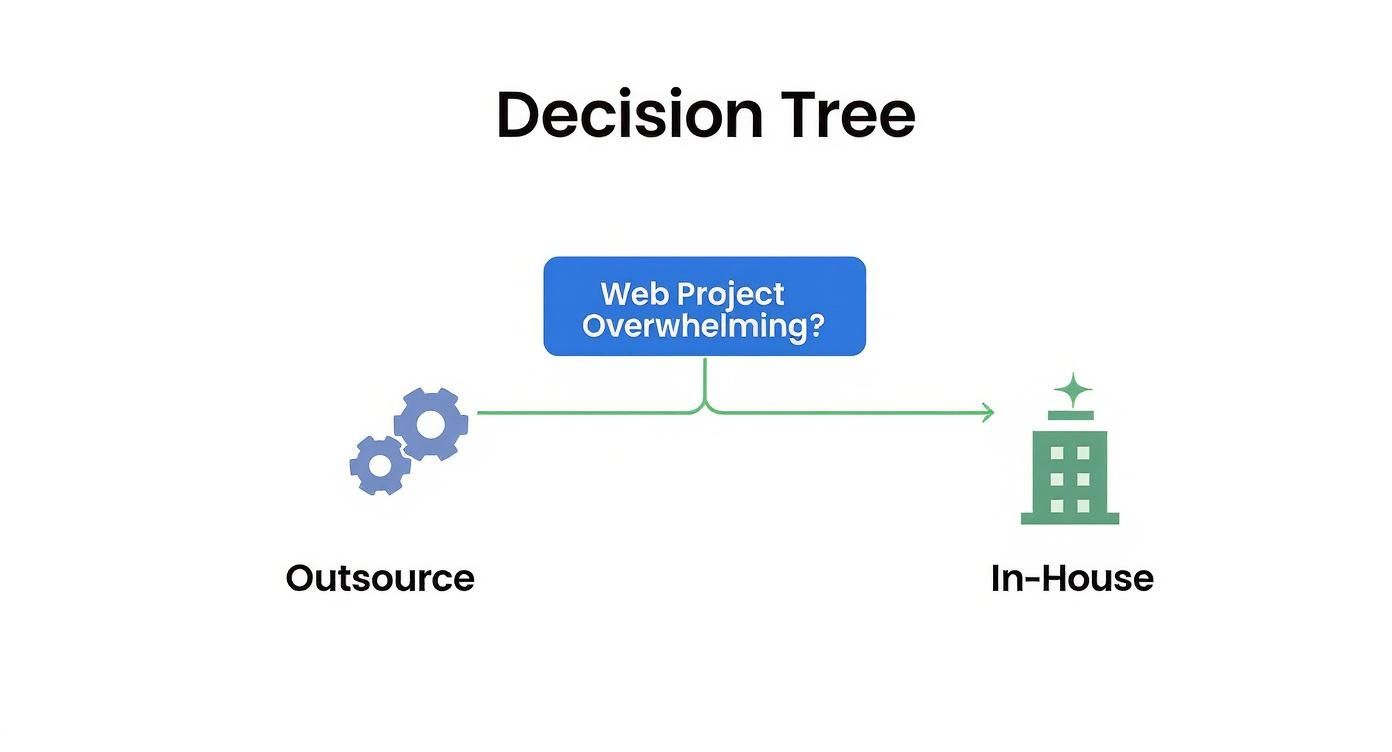
It boils down to a pretty straightforward question: is this project bigger than what your team can handle right now? If the answer is yes, then it’s time to seriously explore your outsourcing options. Let’s dive into what those actually look like.
The Freelancer Model
Hiring a freelancer is the most direct route, especially for specific, well-defined tasks. It’s perfect when you just need an expert to come in and get a single job done.
Think of it for things like:
- Spinning up a quick minimum viable product (MVP) to test an idea.
- Building out a new landing page in a tool like Webflow.
- Creating a specific custom animation or integration.
This approach works best when you have a strong project manager on your side and just need a skilled specialist to execute. The main trade-off is that you’re responsible for all the management, and their availability can be a moving target for longer-term needs.
The Agency Partnership
Working with a web development agency is a completely different ballgame. You’re not just hiring a person; you’re bringing on a complete, pre-built team. You get strategists, designers, developers, and project managers who already know how to work together seamlessly.
This is the go-to option for bigger, more complex initiatives like a full website overhaul, building an e-commerce platform from the ground up, or any project that needs ongoing strategic input and support. The agency takes full ownership, from the initial planning sessions to launch day and beyond. For a deeper dive into the mechanics, this practical guide to IT outsourcing development is a fantastic resource for mapping out your strategy.
When you hire an agency, you’re buying an outcome, not just a block of hours. You're investing in a managed process and a partner who is accountable for delivering a polished, final product that actually moves the needle for your business.
The Dedicated Team Model
The dedicated team model is for the long haul. This is where an external company provides you with a full team of developers and other specialists who work only for you. They become a genuine extension of your in-house crew, adopting your workflows, sitting in on your meetings, and integrating into your company culture.
This is the ideal setup for companies that need a high, consistent level of development work over months or even years but want to skip the massive headache and overhead of recruiting, hiring, and managing a full-time international team themselves.
Comparing Web Development Outsourcing Models
Seeing these models side-by-side can make the choice much clearer. This table breaks down the key differences to help you figure out which lane is right for your project.
ModelBest ForTypical Cost StructureProsConsFreelancerSmall, defined tasks & MVPsHourly or Per-ProjectCost-effective, flexible, direct communicationYou manage them directly, potential for unavailabilityAgencyComplex, end-to-end projects & redesignsFixed Project Price or RetainerFull-service expertise, managed process, accountable for resultsHigher cost, less direct control over individual developersDedicated TeamLong-term projects & team augmentationMonthly Retainer Per Team MemberDeep integration, acts as an extension of your team, scalableHighest cost, requires significant management oversight
Ultimately, choosing the right engagement model is one of the most important decisions you'll make when outsourcing web development. Aligning the model with your project's reality and your company's goals is what sets you up for a partnership that doesn’t just work, but truly succeeds.
The Real Benefits of Outsourcing Web Development
It’s easy to think of outsourcing web development as just a way to cut costs. That’s an old-school view, and honestly, it misses the point. While you’ll almost certainly see some financial upside, the real wins are the strategic ones—the moves that help you grow faster and outmaneuver the competition. It’s less about pinching pennies and more about gaining a powerful new capability.
Right off the bat, you get access to a global talent pool. Let’s say you need a developer who's a wizard with complex Webflow animations or someone who’s an expert at weaving together tricky third-party API integrations. Trying to find, vet, and hire that person in your local market could take months and cost a fortune. Outsourcing opens the door to these specialists, ready to go when you are.
This isn’t just about hiring a pair of hands, either. You’re bringing on a team that’s already tackled similar challenges for other businesses. They’ve seen what works and what doesn't, allowing them to sidestep common pitfalls and build on proven solutions from day one.
Get to Market, Faster
In today’s market, speed is everything. Outsourcing can drastically shorten the runway from a great idea to a live product. While your competitors are bogged down in the traditional hiring process—writing job descriptions, sifting through resumes, and onboarding new staff—your outsourced team is already deep in the code, building and shipping.
This isn't just a feeling; it's a measurable advantage. Studies have shown that a hybrid or outsourced model can increase delivery speed by up to 37%. For many companies, that translates to launching a minimum viable product a full 7 weeks faster than if they had relied solely on an in-house team.
Think of it this way: outsourcing lets you bypass the typical resource bottleneck. You can instantly scale your development firepower up or down as your project demands, giving you the right people at the right time without the overhead of full-time hires.
Sharpen Your Focus on What Really Matters
One of the most powerful, and often overlooked, benefits is the freedom it creates for your own team. By handing off the technical heavy lifting, you allow your key people to step away from the nitty-gritty of project management, bug-squashing, and development sprints.
This frees them up to focus on what they do best—the high-value activities that actually drive your business forward.
- Your product team can get back to innovating and shaping the roadmap.
- Your marketing team can put all their energy into strategy and winning new customers.
- Your leadership can focus on the big picture: strategy and growth.
This is precisely why outsourcing is now seen as a core part of operational excellence. While cost reduction still drives 59% of these decisions, the quest for efficiency is right there with it. In fact, a whopping 78% of businesses now outsource to improve their operations and speed up innovation. You can dig into more detailed statistics on software development outsourcing to see just how big this trend has become.
At the end of the day, outsourcing turns a fixed cost (a full-time salary) into a flexible one, often leading to savings between 15% and 70%. But more importantly, it gives you the agility, specialized talent, and strategic focus you need to not just keep up, but to pull ahead.
Finding and Vetting the Right Development Partner
Let’s be honest: choosing who to outsource your web development to is the single most important decision you'll make in this entire process. It’s the make-or-break moment that determines whether your project soars or face-plants. This isn't just about finding a team with a slick portfolio; it's about finding a genuine partner who gets your vision and has the technical muscle to bring it to life.

You can’t just wing the vetting process. You need a game plan to look past the sales pitch and see how a potential partner actually thinks, communicates, and tackles problems. When you're ready to start your search, this guide on hiring a website development outsourcing company is a fantastic resource to have in your back pocket.
Looking Beyond the Portfolio
A flashy portfolio is just the entry ticket. Every half-decent agency has one. Your job is to find proof of successful partnerships, not just pretty pictures.
Start by really digging into their case studies. Do they clearly explain the business problem they were hired to solve? And more importantly, do they show actual, measurable results? I’m talking about things like increased traffic, better conversion rates, or faster page loads. A solid case study tells a clear story: here was the problem, here’s how we solved it, and here’s the proof it worked.
Next, read their client testimonials with a critical eye. Vague praise like "they were great to work with" is nice, but it doesn't tell you much. You’re looking for specifics. Something like, "they spotted a critical performance issue we totally missed and had it fixed within 24 hours"—now that's telling.
Assessing Technical and Cultural Fit
Technical chops are obviously non-negotiable. But it’s the cultural fit that makes or breaks a long-term partnership. You need a team that communicates in a way that works for you, shares your sense of urgency, and cares about quality as much as you do.
Pay close attention during your initial calls. Are they just asking about your scope and budget? Or are they asking the right questions—the ones that dig into your business goals and who your customers are? A real partner is curious about your "why," not just your "what."
This is especially true if your site is built on a specific platform like Webflow. You need a team that truly lives and breathes it. Don’t be afraid to get specific and ask about their hands-on experience with common Webflow headaches.
Actionable Questions for Webflow Site Owners:
- How do you handle class naming and style guides in Webflow to make sure the site is easy to maintain down the road?
- Can you show me an example of a really complex CMS structure you've built?
- What’s your process for optimizing site speed and Core Web Vitals specifically within Webflow?
Their answers will quickly tell you if they're true Webflow pros or just faking it.
Creating a Request for Proposal That Attracts Quality
A well-written Request for Proposal (RFP) is your best filter. It attracts the serious, high-quality partners you want and politely weeds out the ones who aren't a good fit. An RFP shouldn't just be a laundry list of features; it needs to tell a story and provide context.
Here’s what your document should include:
- Company Background: A quick snapshot of who you are, what you do, and who you serve.
- Project Goals: Get specific. What business result are you after? More leads? Better user engagement? A site that doesn't crawl?
- Target Audience: Paint a picture of your ideal customer. This helps the agency understand who they’re really building for.
- Scope and Deliverables: Outline the must-have features and functionality. If you know you have gaps, like a weak content strategy, you can mention that. For inspiration, learning how to perform a content gap analysis for SEO can help you define those needs.
- Technical Stack: Mention your key platforms (Webflow, especially) and any must-have integrations.
- Budget and Timeline: Be realistic. Providing a clear range for both saves everyone a ton of time.
A great RFP isn't a demand—it's an invitation to a strategic conversation. It shows a potential partner that you’ve done your homework and you’re looking for a collaborator, not just a pair of hands to execute a task list.
Following this structured approach turns the search from a guessing game into a methodical process. It lays the groundwork for a successful partnership built on clarity, trust, and mutual understanding from day one.
A Guide to Outsourcing Your Webflow Development
So, you're using Webflow. You know it’s more than just a drag-and-drop tool; it's a full-fledged visual development platform that can create some seriously impressive websites. But to really unlock its power—think complex CMS setups, custom integrations, and buttery-smooth animations—you often need a specialist. This is where outsourcing your Webflow development can make all the difference, but a successful project hinges on a clean handoff.

Think of it like getting your car ready for a tune-up. You wouldn't leave a pile of junk on the passenger seat and expect the mechanic to work around it. You clean it out so they can get right to work. Prepping your Webflow site does the same thing for a developer—it saves everyone time, money, and a whole lot of headaches.
Preparing Your Webflow Site for a Smooth Handover
Before you even start interviewing potential partners, it’s worth spending a little time getting your project organized. A bit of upfront effort ensures any developer can jump in, understand your setup, and start delivering value from the get-go. A well-organized project is the bedrock of any successful outsourcing web development partnership.
Tutorial: Create a Maintainable Style Guide in Webflow
This is the non-negotiable first step. A global style guide keeps everything consistent and makes site-wide updates a simple, one-click affair.
- Create a "Style Guide" Page: Build a new static page in your Webflow project named "Style Guide" or "Brand Kit."
- Set Up Global Colors: In the Style panel, go to the color swatches. Add your primary, secondary, and accent colors. Critically, click the gear icon for each and check "Save as a Global Swatch." This means if you update a global color, it changes everywhere on the site.
- Define Typography: Drag in a heading element. Style your H1 perfectly (font, size, weight, color). Then, in the Selector field, select "All H1 Headings" and apply the style. Repeat this for H2 through H6 and Paragraphs. Now every heading you add will automatically inherit these styles.
- Style Global Classes: Create elements for buttons, links, and form fields. Style them using a clear class name (e.g.,
button-primary). This ensures every button on your site looks identical.
Tutorial: Clean Up Your Class Naming System
Nothing makes a developer's eye twitch more than a chaotic mess of classes like Div Block 27. A logical system makes the project scalable and easy for anyone to understand. A popular method is Finsweet's Client-First system.
- Understand the Structure: The core idea is simple: use logical, readable class names. A common format is
component_element-modifier. For example,nav_link-activeclearly indicates an active link within the navigation component. - Audit Your Existing Classes: Go through your Navigator panel page by page. Look for generic, auto-generated class names.
- Rename Systematically: Select an element with a bad class name. In the Style panel, double-click the class name to rename it. Start with your main layout components (e.g.,
section_main,container_large). - Remove Unused Classes: In the Style Manager panel (G key), you can see all classes in your project. Click "Clean up" to remove any classes that are no longer attached to an element.
Handing over a clean, well-documented Webflow project is the difference between a quick start and a frustrating, time-consuming audit. It shows respect for your developer's time and sets a professional tone for the partnership.
High-Value Tasks Perfect for Outsourcing to Webflow Experts
With your site prepped and ready, you can start handing off the more complex jobs that demand a specialist's touch. These are the projects where a true expert can deliver a massive return on your investment.
An experienced Webflow developer can tackle challenges that go way beyond building simple landing pages.
Advanced Integrations and Animations
This is a big one. Think about connecting Webflow to the other tools that run your business. An expert can seamlessly link your site to CRMs, marketing automation platforms, and other third-party services using APIs or tools like Zapier and Make.
They can also bring your site to life with advanced interactions and animations using libraries like GSAP (GreenSock Animation Platform). This lets you create those slick, dynamic user experiences that just aren't possible with Webflow's built-in tools alone.
Complex Site Migrations and Maintenance
Thinking of moving a big, content-heavy site from WordPress to Webflow? That’s a job you definitely want to outsource. It’s a delicate process that involves careful planning to protect your SEO, redirect all your old URLs, and rebuild your CMS without losing a single blog post.
Ongoing maintenance is another perfect task to hand off to a trusted partner. This isn't just about fixing bugs; it's about proactive care:
- Performance Monitoring: Regularly checking site speed and optimizing images to keep load times snappy and Core Web Vitals in the green.
- Security Checks: Keeping a watchful eye on any custom code or integrations for potential security holes.
- SEO Health: Running routine technical SEO checks is crucial. A great place to start is learning how to do an SEO audit to catch and fix problems before they impact your search rankings.
- Content Updates: Helping your team get new content published quickly and ensuring it looks perfect on every device.
By getting your site in order first and then strategically choosing what to delegate, you can turn outsourcing web development into a powerful strategy for taking your Webflow site from a simple online presence to a core part of your growth engine.
How to Manage Your Outsourced Project Effectively
So you’ve found the right partner. Great! But the hard work isn't over—in fact, it's just beginning. The real test of an outsourced web development project isn't just the final product, but how you get there. Success truly boils down to how you manage the relationship and workflow from day one.
This isn’t about looking over their shoulder every five minutes. Effective management is about building a system based on clarity, open communication, and mutual trust. It’s about getting everyone on the same page and keeping them there.
Think of yourself as the director of a movie. You’re not supposed to act out every scene yourself. Your role is to communicate a clear vision, set the stage, and empower each department—in this case, your development team—to bring their best work to the table. They’re your partners, not just a task-list-ticking service.
Get Communication and Collaboration Right from the Start
A solid communication plan is the bedrock of any successful outsourced project. When things get vague, progress stalls. You need to create a predictable rhythm for updates, questions, and feedback right out of the gate. This is how you get ahead of the small misunderstandings that can snowball into major delays and budget blowouts.
Your toolkit doesn't need to be complicated, just consistent. A tool like Slack is perfect for those quick daily check-ins and one-off questions. For the bigger picture, a project management platform like Asana or Trello will help everyone see who’s doing what and when it’s due.
Most importantly, get regular meetings on the calendar and treat them as non-negotiable. A weekly sync is often the sweet spot to review what's been done, tackle any roadblocks, and align on the next week's priorities. Keeping your project's knowledge base organized is just as crucial; a good internal linking strategy within your documentation can make finding information a breeze for everyone involved.
The best project management isn't about having the fanciest tools; it's about building a culture of transparency. When your outsourced team feels like a genuine extension of your own, they’ll be far more motivated to solve problems proactively and deliver their best work.
Set Clear Milestones and Define What Success Looks Like
A huge, single deadline like "launch the website" is a recipe for stress and confusion. To keep your project from feeling overwhelming, you need to slice it into smaller, more manageable pieces—these are your milestones.
For example, a project timeline might look something like this:
- Week 2: Finalize all wireframes and user flow diagrams.
- Week 4: Complete the UI/UX design mockups for key pages.
- Week 8: Finish front-end development for the core site experience.
- Week 10: Complete the full CMS integration and backend setup.
But milestones are only half the story. You also need to define your Key Performance Indicators (KPIs). These are the hard numbers that tell you whether the project is actually on track. Don't get caught up in just tracking hours; focus on the outcomes that truly matter.
Here are a few essential KPIs to keep an eye on:
- Project Velocity: Is the team completing work at the pace you both agreed on?
- Budget Adherence: How is your spending tracking against the budget set for each milestone?
- Bug Rate: How many issues are popping up during the quality assurance (QA) phase? A high number might point to deeper problems.
- User Acceptance: When it's all said and done, does the final product actually meet the needs and requirements you laid out in the beginning?
By actively managing the flow of communication, setting crystal-clear goals, and measuring what actually matters, you can turn outsourcing web development from a gamble into a predictable, high-value partnership.
Frequently Asked Questions About Outsourcing
Thinking about outsourcing your web development? You've probably got a lot of questions. That’s a good thing. Getting straight answers is the only way to feel confident you're making the right move for your company. Let’s walk through some of the most common questions we hear.
What Are the First Steps to Prepare for Outsourcing?
Before you even start looking for a partner, the most important work is internal. You need to get crystal clear on what you're building and, more importantly, why. This isn't just about tech specs; it's about business strategy.
Start by writing down your project's main goals. Who is this for? What specific problem does it solve for them, or for your business? From there, you can sketch out a project brief that details the must-have features and functionality. Having this clarity from the get-go makes it infinitely easier to find the right team and get realistic quotes you can actually compare.
How Do You Handle Intellectual Property and Security?
This is a huge, and completely valid, concern. The good news is that it’s easily handled with the right legal paperwork. Your intellectual property (IP) and data security should be top of mind from your very first conversation with any potential partner.
The first line of defense is a Non-Disclosure Agreement (NDA). Always have one signed before you share any sensitive details. Then, your main contract—often called a Statement of Work (SoW)—must have a clause that clearly states your company retains 100% ownership of all code, designs, and anything else created for the project.
Beyond the legal docs, ask about their security practices. How do they manage sensitive data and access credentials? Do they use secure development environments? A professional team will have solid, reassuring answers ready for you.
How Much Does It Cost to Outsource Web Development?
There’s no one-size-fits-all answer here. The cost can swing wildly based on three main things: the type of partner you hire, where they’re located, and how complex your project is.
To give you a ballpark idea of hourly rates:
- Freelancers: You can expect to pay anywhere from $25 to $150 per hour, depending on their experience and location.
- Agencies: Agency rates are a bit higher, typically starting between $50 and $250 per hour. You're not just paying for a developer, but for a whole managed team and process.
It’s easy to get fixated on finding the lowest hourly rate, but that can be a trap. A more experienced developer might cost more per hour but can often work faster and produce higher-quality work, saving you a ton of money and headaches down the road. Focus on the value and expertise they bring to the table, not just the number on the invoice.
Can I Outsource Only a Part of My Web Development?
Yes, absolutely! In fact, this is a very smart and common way to do it. Many companies find a sweet spot with a hybrid model, keeping core strategy and product management in-house while outsourcing very specific development tasks.
This is a great way to augment your current team. You might need someone with deep expertise in complex Webflow animations, a tricky API integration, or just someone to handle ongoing site maintenance. Outsourcing lets you bring in that specific skill set precisely when you need it, without the overhead of hiring a full-time employee.
Ready to turn your website into a reliable growth engine? Block Studio LLC offers a unified team of Webflow developers, SEO specialists, and content strategists to drive measurable results for ambitious companies. Stop juggling freelancers and start building a high-performance website that attracts qualified traffic and converts visitors into customers. Learn how Block Studio can accelerate your growth today.