.png)


Designing a High-Performance Marketing Team Structure
Forget the old-school, rigid org chart. A modern marketing team structure is all about creating small, agile units that have everything they need to run complete campaigns and get results. It’s less about siloed departments and more about building a nimble system focused on speed, smart decisions, and the customer’s experience from start to finish.
Building Your Marketing Engine for Modern Demands
In a market that changes overnight, a clunky, slow-moving marketing department is a massive handicap. You need to think of your team less like a corporate hierarchy and more like a high-performance engine, where every part works together seamlessly to accelerate growth. The best structures aren't built on top-down commands; they're designed to be responsive and quick on their feet.
This really boils down to being agile and obsessed with your customer. We're seeing a huge shift away from the classic setup where content, SEO, and paid media teams barely talk to each other. The new standard is the cross-functional "pod"—a small, self-sufficient team with all the skills on board to take a campaign from idea to launch. This lets them react to what the market is telling them in real-time, not weeks later.
The Shift to Agile and Customer-Centric Teams
The big idea here is that the "perfect" structure isn't a static document you create once and forget. It's a living blueprint that grows and changes with your company. It has to bend and flex as your goals, tools, and customer behaviors evolve, which is absolutely vital for any scale-up trying to find its footing.
Building this kind of marketing engine comes down to a few core principles:
- Data-Informed Decisions: Teams don't wait for marching orders from the top. They use live data to steer their strategy and make adjustments on the fly.
- Cross-Functional Collaboration: Instead of slow handoffs, you have designers, writers, SEO pros, and campaign managers all working in the same unit. This breaks down communication barriers and speeds everything up.
- Focus on Outcomes, Not Tasks: The goal isn't just to check off a to-do list. Success is measured by the actual impact on the business, whether that's generating more qualified leads or keeping customers happy. These agile pods are constantly testing new demand generation tactics to see what moves the needle.
Three Core Marketing Team Structures at a Glance
So, where do you start? To help you get your bearings, I've put together a quick summary of the three most common structures people are using today. Think of this table as a cheat sheet to quickly see which model might be the right fit for your company’s current stage and what you’re trying to achieve.
Structure ModelBest ForKey BenefitFunctionalEarly-stage companies or those needing deep expertise in specific channels.Fosters specialized skills and clear ownership within disciplines like content or SEO.Cross-Functional (Pods)Growth-stage companies focused on speed, experimentation, and customer journey alignment.Increases execution speed and accountability by embedding all necessary roles in one team.HybridMature organizations balancing the need for speed with centralized governance.Combines the agility of pods with shared access to specialized central resources.
Each of these models has its place, and choosing the right one depends entirely on your specific needs. If you're looking for an even more in-depth breakdown, this comprehensive guide to B2B marketing team structure is a fantastic resource for building a team that's ready for today's challenges.
How Marketing Teams Evolve from Startup to Enterprise
Your marketing team structure isn't something you set in stone. It’s a living, breathing part of your business that needs to adapt as you grow. Think of it like an oak tree—it starts as a tiny acorn and slowly branches out into a complex, powerful system. If you want to hire the right people at the right time, you have to understand this natural progression.
The journey from a scrappy startup to a global enterprise isn't a straight line. Each phase brings its own marketing priorities and unique challenges. Try to build an enterprise-level team too soon, and you'll burn through cash. Wait too long to specialize, and you'll stall out completely. The real secret is matching your team's design to where your company is right now.
The Startup Phase: The Versatile Generalist
In the very beginning, marketing is all about survival. You’re working with a shoestring budget, you’re desperately trying to find product-market fit, and the name of the game is doing more with less. This is the era of the versatile generalist—usually a lone Digital Marketing Manager or a tiny team of one to three people.
This first hire has to be a marketing Swiss Army knife. One day they're running social media campaigns, the next they're writing blog posts, and the day after that they’re piecing together an email automation. Perfection isn't the goal; speed and learning are. Their job is to get the brand's name out there, generate the first few trickles of traffic, and figure out which channels actually have potential.
This lean approach makes the team incredibly agile. An idea can go from a thought to a live test in a single afternoon, with no management layers or departmental handoffs to slow things down. It’s all about being scrappy, testing everything, and focusing on the foundational work that proves the business can actually grow.
The Growth Stage: Introducing Specialization
Once a company starts getting some traction and a bit more funding, the generalist model starts to show its cracks. The jack-of-all-trades can’t go deep enough into any one channel to keep up with the growing demand for leads and revenue. This is the inflection point where you have to specialize to scale.
Here, the team expands to include experts who can truly own critical growth channels. A Head of Growth is often the first major hire, someone who can oversee the whole strategy and make sure every marketing effort ties back to the company's goals. They then start building out their team of specialists.
Key roles you'll see pop up during this stage include:
- Content Marketing Manager: Creates and executes a content plan to attract and educate the right kind of leads.
- SEO Specialist: Goes deep on organic search to drive high-intent traffic from people actively looking for a solution.
- Paid Search Marketer: Manages and optimizes ad campaigns to generate a predictable return on every dollar spent.
- Conversion Rate Optimizer (CRO): Dives into user behavior and runs experiments to get more value out of existing website traffic.
This shift creates a much more powerful marketing engine. Each part is now finely tuned by an expert to perform its function at a much higher level.
The Enterprise Stage: Building for Scale and Dominance
When a company hits the enterprise level, the marketing team transforms again into a sophisticated, multi-layered organization. The goal is no longer just growth; it’s about market leadership, global reach, and running a massive operation efficiently. Leadership gets more stratified, and teams are often broken out by function, region, or even product line.
A Chief Marketing Officer (CMO) usually sits at the top, setting the grand vision. Reporting to them are VPs who oversee huge divisions like brand, acquisition, or international marketing. This isn't just theory; research shows that these structures evolve in a predictable way. Startups are lean, growth-stage companies build out balanced teams under a Head of Growth, and enterprises develop deep leadership benches and specialized teams for everything you can imagine. You can see a great breakdown of these evolutionary marketing team structures to understand how they adapt at each stage.
This flowchart illustrates a modern, customer-first hierarchy that many successful companies are moving toward. It puts the customer at the very top, supported by agile pods, and guided by leadership.
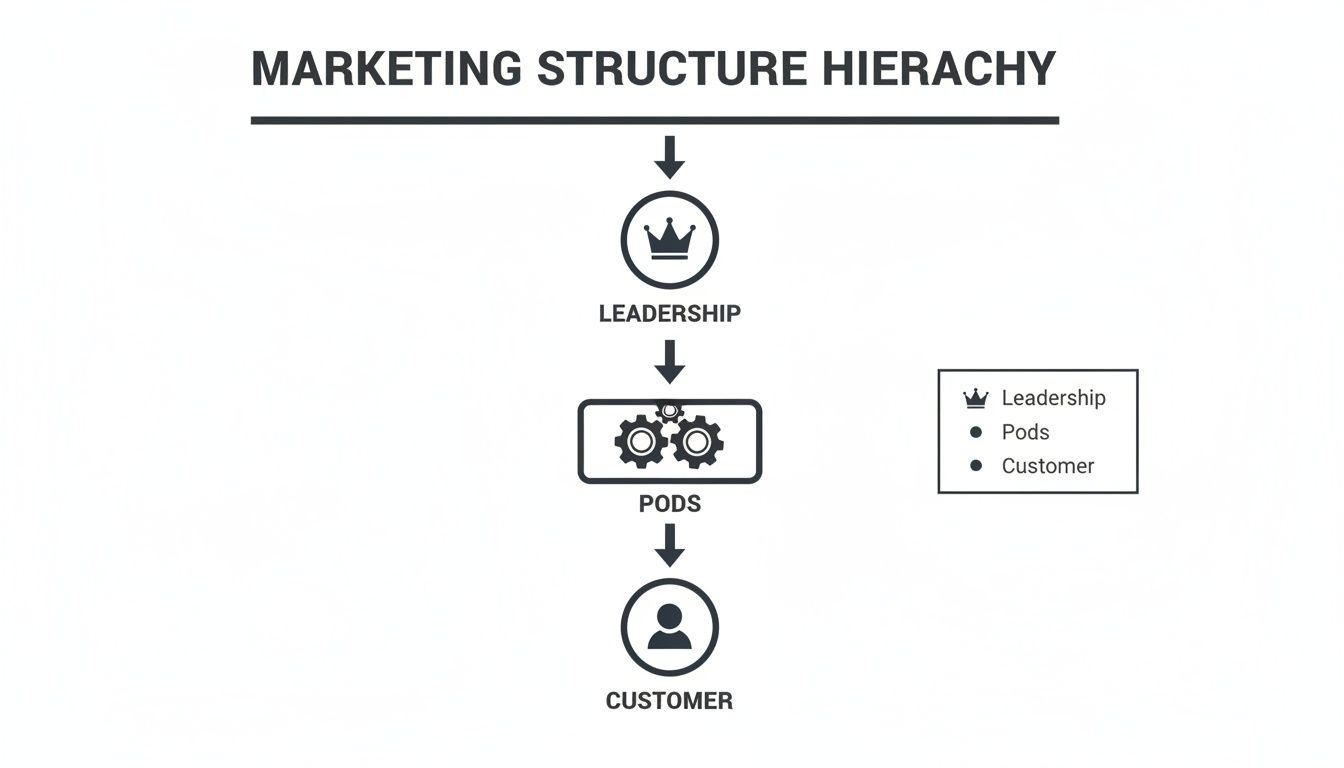
This model flips the old pyramid on its head. It’s a powerful reminder that the entire organization—from the C-suite down to the individual teams—exists for one reason: to serve the customer. Each stage of a company's evolution is really just an attempt to get better and better at doing just that.
Choosing Your Model: In-House, Hybrid, or Outsourced
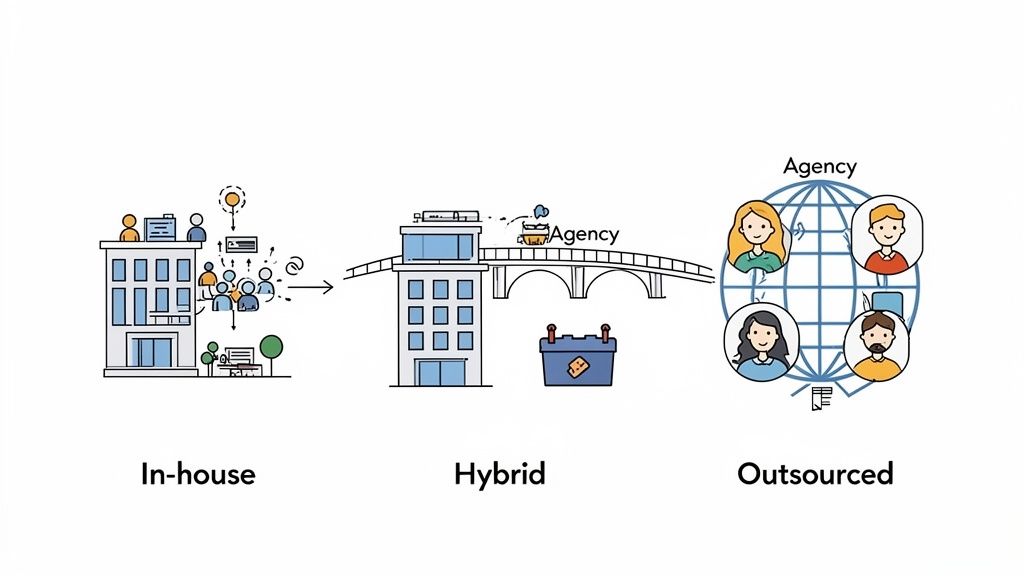
One of the biggest decisions you'll make when scaling your marketing isn't just who to hire—it's how to build your team. You're essentially choosing between three playbooks: keeping everything in-house, farming it all out to an agency, or finding a sweet spot in the middle with a hybrid model. Each approach comes with its own set of very real pros and cons.
A fully in-house team gives you ultimate control. Your people live and breathe your brand every single day, which usually leads to more authentic, cohesive messaging. But let's be honest, it's also expensive and can make you slow to react. Hiring a full-time expert for every single marketing channel just isn't realistic for most companies.
Flipping the coin, a fully outsourced model gets you instant access to a whole roster of specialists without the overhead of salaries, benefits, and equipment. The trade-off? You give up a lot of control, and you run the risk of your agency partner never quite getting the nuances of your brand's voice.
The Rise of the Hybrid Marketing Team
The old way of doing things—where the in-house team set the strategy and an agency just executed—is starting to break down. It's too slow and siloed for today's pace. Instead, we're seeing the sharpest companies shift to a much more fluid hybrid approach.
In this modern setup, you keep your core strategic brainpower in-house. Things like brand direction, customer research, and high-level planning stay close to home. Then, you bring in outside specialists for the highly technical or fast-moving parts, like performance marketing, technical SEO, or video production.
This isn't just a trend; it's a direct response to what's happening in the market. There's a serious talent shortage in specialized fields like analytics and AI, senior-level salaries are sky-high, and everyone needs to produce more content, faster. A hybrid model is the most practical solution to all three problems.
A hybrid model gives you the best of both worlds: the strategic core of an in-house team combined with the specialized, on-demand firepower of external experts. It's about building an agile team that can scale its capabilities without ballooning its headcount.
Making the Right Choice for Your Business
So, how do you decide? It really boils down to balancing four things: cost, control, scalability, and access to talent. Getting clear on these will point you in the right direction.
Here's a simple framework to help you think it through:
- Cost Efficiency: Don't just look at salary vs. retainer. Think about the total cost of ownership. A full-time employee comes with benefits, training, software licenses, and other overhead. Often, tapping a specialist freelancer or agency for a specific need is far more budget-friendly.
- Strategic Control: What parts of your marketing are absolutely non-negotiable to own internally? For most, it's the brand voice, core messaging, and the overarching strategy. These are the soul of your company and should stay in-house to keep them aligned with your business goals.
- Scalability Needs: How quickly do your marketing needs change? If you’re constantly experimenting with new channels or need to spin up a huge campaign for a product launch, a hybrid model is your friend. It lets you tap into outside help almost overnight, then scale back down just as fast.
- Access to Expertise: Let's face it, some skills are incredibly hard—and expensive—to hire for. Think top-tier technical SEO or advanced paid media optimization. Outsourcing gives you a direct line to elite talent you probably couldn't attract or afford as a full-time hire. For a deeper look, understanding how digital marketing outsourcing works can be a game-changer.
Ultimately, you’re trying to build a marketing machine that's both powerful and sustainable. For most modern tech and B2B companies, that means having a small, sharp strategic team in-house that manages a trusted network of external partners.
This same logic applies to technical execution, too. For instance, weighing the pros and cons of outsourcing web development can show you how this flexible model works well beyond just marketing campaigns.
Integrating AI to Create Superpowered Marketing Squads
It’s impossible to talk about modern marketing teams without talking about Artificial Intelligence. Many people immediately jump to the conclusion that AI is here to replace jobs, but that’s a pretty limited way of looking at it. The reality is far more interesting.
Think of AI as a powerful team amplifier. It’s creating what many of us are now calling "superpowered" marketing squads. Instead of replacing talented people, AI is taking over the repetitive, soul-crushing tasks that used to eat up most of their day. This frees your team to focus on what humans do best: big-picture strategy, creative breakthroughs, and connecting with customers on a real level.

From Manual Execution to Strategic Oversight
The ripple effect of AI is completely reshaping marketing roles from the inside out. Take a content strategist, for example. In the old model, they were buried in keyword research, manually drafting outlines, and managing a handful of writers just to get a few articles out the door each month.
Now, give that same strategist a good AI tool. They become a force multiplier. They can generate first drafts in minutes, optimize content for search engines instantly, and get performance data back in real-time. Suddenly, one person can manage the output of a small team, freeing them up to think bigger—tackling ambitious pillar pages and building out entire topic clusters.
This isn’t just a content thing, either. A campaign manager can now oversee far more complex, multi-channel initiatives because AI automation is handling the ad bidding, audience segmentation, and A/B testing. Their job shifts from pulling levers to designing the machine and fine-tuning its overall strategy.
Building Smaller, Sharper Teams
This isn't some far-off future trend; it's happening right now. We're seeing a massive shift as 60% of marketing departments worldwide are already weaving at least one AI technology into their day-to-day. As you can see from these AI marketing statistics for 2025, this is changing the very DNA of marketing teams.
With routine tasks automated, human roles are naturally pivoting toward higher-value work. The result is smaller, sharper teams that prioritize brainpower over headcount.
The goal of integrating AI isn't to shrink your team for the sake of cutting costs. It's about empowering a leaner, more strategic group of experts to achieve outcomes that were previously out of reach. It’s about trading tedious manual labor for creative and strategic leverage.
Think of AI as the ultimate co-pilot for your marketing experts. It can chew through massive datasets to find hidden customer insights, predict which leads are ready to buy, or even personalize website content for every single visitor. Your team’s job is to interpret those insights, craft the story, and make the final strategic call.
Real-World Impact on Roles
The shift from "doing the work" to "directing the work" is the most critical change to understand when building a modern marketing team. The table below shows how this plays out in a few key roles.
AI's Impact on Traditional vs Modern Marketing Roles
This table gives a side-by-side look at how specific roles are evolving. Notice the common thread: AI handles the heavy lifting, allowing the human expert to focus on strategy, quality, and optimization.
Ultimately, bringing AI into your team is less about the technology itself and more about a new philosophy. It’s about building a structure where every person is elevated to their most strategic and creative self, while the machines handle the rest. This creates a marketing engine that isn't just more efficient—it's smarter and far more ready for whatever comes next.
Your Playbook for Webflow SEO and Content Alignment
If your marketing team runs its site on Webflow, you know it's a powerful tool. But to unlock real growth, your technical, SEO, and content teams must work in perfect sync. When they operate in silos, you end up with a beautiful website that's invisible to search engines and fails to convert visitors.
This playbook provides an actionable framework to align your teams. We’ll break down how to structure roles, workflows, and testing processes specifically for Webflow to turn your site into a reliable growth engine.
Step 1: Define Clear Ownership with a RACI Chart
Ambiguity kills productivity. If no one knows who’s responsible for fixing a broken redirect or who has the final say on the content calendar, critical tasks will fall through the cracks. The first step is to establish absolute clarity on roles.
A RACI chart is the perfect tool for this. It maps out who is Responsible, Accountable, Consulted, and Informed for every key task, creating a single source of truth for your entire team.
Here’s a sample RACI chart tailored for a marketing team using Webflow:
This chart instantly clarifies workflows. For example, the SEO Specialist is accountable for keyword research, but the Head of Content must be consulted to ensure the keywords align with the broader content strategy. This simple structure prevents wasted effort and keeps everyone aligned.
Step 2: Implement a Keyword-to-Conversion Workflow in Webflow
With roles defined, you can build a streamlined process that ensures SEO is integrated from the start, not just tacked on at the end.
- Keyword Strategy (SEO Specialist): The SEO Specialist identifies high-value keywords and topic clusters that align with business goals. They are accountable for finding organic growth opportunities.
- Content Brief Creation (SEO Specialist & Head of Content): The SEO Specialist translates keyword research into a detailed content brief. The Head of Content reviews it for brand alignment. An editorial calendar template can help organize this process.
- Writing & Review (Content Writer & Head of Content): The Content Writer drafts the article. The Head of Content edits for quality, tone, and accuracy.
- Publishing in Webflow CMS (Content Writer): The writer uploads the final content to the Webflow CMS. Actionable Tip: Train your writers to use Webflow's built-in SEO settings for each post. They should be responsible for setting the Title Tag, Meta Description, and Open Graph settings directly within the CMS page settings before hitting "Publish."
This workflow empowers content creators to manage the entire publishing process, freeing up developers to focus on more complex technical tasks.
Step 3: Systematize A/B Testing on Webflow Landing Pages
Continuous testing is essential for growth. A structured process for running A/B tests on your Webflow landing pages prevents chaos and ensures you learn from every experiment.
- Hypothesis & Ideation (CRO Specialist): This role owns the testing roadmap. They analyze user behavior and data to form hypotheses (e.g., "Changing the CTA button color from blue to orange will increase form submissions by 10%").
- Implementation (Webflow Developer/Designer): The developer or designer builds the variant page in Webflow. Actionable Tip: Instead of building from scratch, simply duplicate the original page in Webflow. This creates an exact copy that you can modify for the test, saving significant time and ensuring consistency. Rename the duplicate page with a clear testing slug (e.g.,
/landing-page-variant-b). - Analysis & Reporting (CRO Specialist/Data Analyst): The analyst interprets the results using a third-party tool like Google Optimize or VWO, determines statistical significance, and reports on the outcome. These findings inform the next round of tests.
By structuring your Webflow operations this way, you create a repeatable system for growth. Every role has a clear purpose, every task has an owner, and your website becomes a true engine for attracting and converting customers.
Frequently Asked Questions About Marketing Team Structures
When you're in the trenches building a marketing team, a lot of the same practical questions pop up time and again. Getting these right from the start can save you a world of headaches down the road.
Let's dig into some of the most common hurdles you'll face, from figuring out who to hire first to knowing when it's time to tear down your org chart and start fresh.
What Is the Most Important First Marketing Hire for a Startup?
For a brand-new startup, your first marketing hire should absolutely be a versatile marketing generalist. Don't fall into the trap of hiring a niche specialist too early. You need a "T-shaped" marketer—someone with broad skills across many channels, but deep expertise in one or two that are critical for you, like content or SEO.
Think of this person as your marketing Swiss Army knife. They're the one who can write a blog post in the morning, launch a simple email campaign after lunch, and dig into the analytics before logging off. Their core job is to experiment, find the first glimmers of what works, and build the basic systems you'll scale later.
How Do B2B and B2C Marketing Team Structures Differ?
While every marketing team is focused on the customer, their structures look very different depending on who that customer is and how they buy. The biggest split you'll see is between B2B and B2C, and it all comes down to the deep integration B2B marketing has with sales.
- B2C Teams are typically built around channels that drive high-volume, direct purchases. You'll see roles like Social Media Manager, Influencer Marketing Lead, and E-commerce Specialist, all focused on building brand love and speeding up a relatively short path to conversion.
- B2B Teams are structured for a long, complex sales journey. This means you need specialized roles you almost never find in B2C, like Sales Enablement (to arm the sales team with content) and Account-Based Marketing (ABM) specialists (to run hyper-focused campaigns on a few high-value accounts).
The core distinction is that B2B marketing teams are fundamentally built to support a direct sales force. Their structure must include roles and workflows dedicated to generating, nurturing, and qualifying leads for sales handoff.
When Should You Re-Evaluate Your Marketing Team Structure?
Your marketing org chart shouldn't be a sacred document gathering dust. It's a living blueprint that needs to change as your business grows. Sticking with a structure that worked last year is a surefire way to kill your momentum.
You should plan to take a hard look at your team's design whenever a major business event happens. Key triggers that scream "it's time for a change" include:
- A New Funding Round: More capital means higher growth expectations. Your team structure has to adapt to handle a bigger budget and a larger headcount.
- Entering a New Market: Whether you're expanding to a new country or targeting a totally different customer, you'll need new skills and maybe even a dedicated "pod" to tackle that market's unique challenges.
- A Major Pivot in Business Strategy: Shifting from a traditional sales-led approach to a product-led growth model requires a complete teardown and rebuild of your marketing team to support the new go-to-market motion.
- Consistently Missing KPIs: If your team keeps falling short of its goals, that's not just a performance issue. It's often a symptom of a broken structure that's creating bottlenecks, misaligning incentives, or simply lacks the right skills to get the job done.
At Block Studio, we don't just build websites; we build the growth engines that power them. We provide a unified team of Webflow, SEO, and content experts to turn your site into your number one source of revenue. Find out how we do it.