.png)

A Modern Professional Services Marketing Strategy That Wins Clients
A professional services marketing strategy isn’t just a collection of tactics; it's your game plan for creating a real, sustainable competitive advantage. It's about deliberately defining who you serve best, sharpening your service offerings, and broadcasting your firm's expertise. The idea is to move past random acts of marketing and build a coordinated system that consistently attracts and wins your ideal clients, making your firm the obvious choice in a sea of competitors.
Defining Your Position in a Crowded Market
Before you can build a marketing engine that pulls in high-value clients, you have to claim your territory. Just being in business isn't a strategy. To really win in professional services, you need an almost obsessive understanding of who you serve, what they truly need, and where your competitors are dropping the ball. This foundational work is what informs every piece of content you create and every dollar you spend.
This isn't about slapping together generic "buyer personas" that end up collecting dust in a shared drive. It's about building a data-backed Ideal Client Profile (ICP) that feels like a real person with real problems you can solve.
From Vague Personas to a Sharp Ideal Client Profile
Generic personas often lead to bland, ineffective marketing. A persona like "Marketing Mary" at a mid-sized tech company is way too broad. It doesn't tell you a thing about her actual day-to-day challenges, what triggers her to look for a solution, or the internal politics she has to navigate to get a new project approved.
An ICP, on the other hand, is sculpted from the data of your most profitable and successful clients. It goes much deeper. Here’s how you can start carving one out:
- Analyze your best clients: Pull a list of your top 10-15 clients. What industry are they in? How big are their companies? What specific services did they buy, and more importantly, what was the business outcome they got?
- Interview your internal experts: Grab time with your sales and account management teams. Ask them which clients are a dream to work with, which ones have the highest lifetime value, and who sends the most referrals your way.
- Uncover the real pain points: What specific, nagging problems did these top clients have before they found you? Were they drowning in inefficient processes, missing a key area of expertise, or hitting a wall trying to scale? Get granular here.
For firms just starting this process, knowing how to structure this research is half the battle. If you need a solid starting point, our guide on how to create buyer personas offers a structured framework you can easily adapt to build your first real ICP.
This exercise is what transforms your understanding from a vague "we serve tech companies" to a laser-focused "we serve Series B SaaS companies with 50-200 employees who are struggling to scale demand gen because their in-house marketing team lacks deep SEO expertise." That kind of clarity is a massive competitive advantage.
Analyzing the Competitive Landscape
Once you have a crystal-clear ICP, you can start analyzing your competition through the eyes of that ideal client. The goal here isn't to copy what they're doing, but to find the gaps in their offerings and messaging. Where are they strong? And, more importantly, where are they vulnerable?
Your competitive analysis should reveal a defensible niche where your firm’s unique expertise directly solves your ICP’s most urgent problem in a way your rivals can’t. This intersection of client need, your strength, and competitor weakness is your strategic position.
To truly stand out in a crowded professional services market, it's essential to cultivate thought leadership within your niche. This is what establishes your authority and makes your firm the go-to resource people seek out.
This flowchart shows the simple yet powerful process of moving from broad analysis to a strong market position.
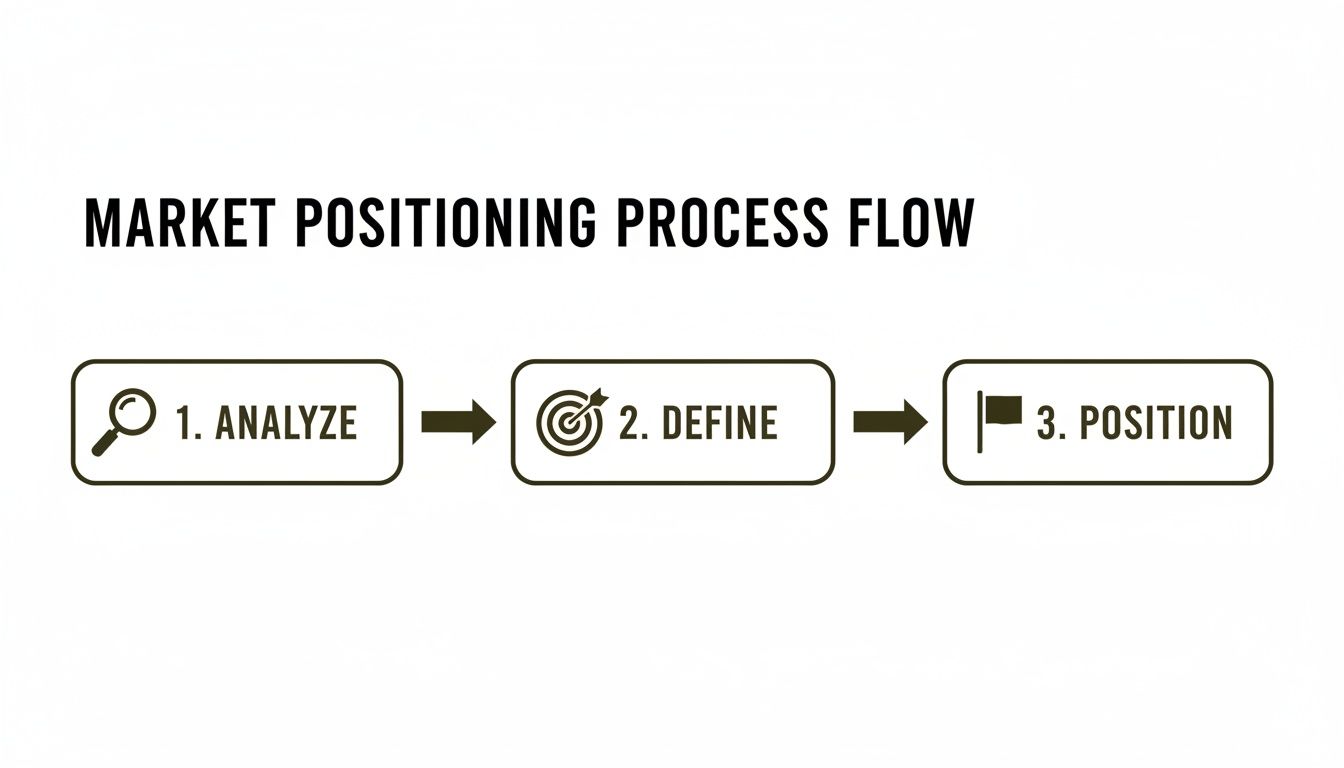
This three-step loop—Analyze, Define, Position—isn't a one-time project. It's a continuous cycle that keeps your marketing sharp and perfectly aligned with the realities of your market.
Crafting a Value Proposition That Resonates
So, you’ve nailed down your ideal client. That’s a huge win, but it’s only half the battle in building a solid professional services marketing strategy. The other half is all about communicating your value in a way that makes that perfect client feel like you truly get them.
Too many firms fall into the trap of leading with a laundry list of services—"we offer tax advisory, audit, and consulting." This does absolutely nothing to set them apart. Your unique expertise gets lost in the noise if a potential client can't immediately connect what you do with the specific problem they're trying to solve.
A powerful value proposition flips the script. It shifts the focus from what you do to the real, tangible outcomes you deliver. It’s the essential bridge between your services and your client's most pressing needs.
From Services to Solutions
Instead of just listing services, start reframing them as solutions to the pain points you uncovered while building out your ICP. This is a subtle but absolutely critical shift in messaging. Think about it in terms of a "before and after" state for your clients.
For example, a corporate law firm doesn't just "offer contract review services." A much more compelling angle is: they "eliminate legal bottlenecks that delay revenue, giving your sales team the confidence to close deals faster." See the difference?
Here’s a simple way to start making this shift:
- The Service: What’s the technical name for what you provide? (e.g., "Webflow SEO audit")
- The Client's Problem: What specific issue are they dealing with? (e.g., "Our organic traffic has flatlined, and the leads we get from the website are junk.")
- The Outcome: What’s the positive, measurable result they can expect? (e.g., "We turn your Webflow site into a predictable source of qualified inbound leads.")
This approach immediately makes your value tangible. You’re no longer just another vendor; you're a strategic partner in their growth, speaking directly to the business results they care about.
A Framework for Compelling Messaging
To keep your message consistent and powerful, you need a simple, repeatable framework. One of the most effective I've ever used comes from Geoffrey Moore's classic book, Crossing the Chasm. It’s brilliant because it forces you to be incredibly concise and client-focused.
The template is straightforward:
For [target client] who [statement of need or opportunity], our [service name] is a [service category] that [statement of key benefit]. Unlike [primary competitive alternative], our service [statement of primary differentiation].
Working through this template is an exercise in clarity. It sharpens your competitive angle and ensures your messaging is differentiated and speaks directly to the client's world.
The Rise of Outcome-Based Models
There’s a major trend reshaping the professional services world right now: the shift away from purely transactional, one-off projects. The most forward-thinking firms are structuring their offerings around subscriptions and value-based outcomes, and this is fundamentally changing how they market themselves.
The industry has been accelerating its move from one-off gigs to recurring and value-based services between 2019 and 2025. Top analyses recommend that firms prioritize subscription offerings to boost lifetime client value and build more predictable revenue streams. In fact, leaders in the space are actively making subscription-based offerings and value-based selling core strategic priorities. You can dive deeper into this trend in TSIA’s State of Professional Services 2025 report.
This model changes the entire marketing conversation. You're not just selling a project; you're selling a partnership and a predictable result. Instead of a "content strategy project," you might offer a "Content Growth Subscription" that includes ongoing strategy, production, and performance reporting for a flat monthly fee. This frames your value as a continuous engine for growth, not just a temporary fix.
Turning Your Webflow Site into a Lead Generation Engine
Think of your website as your best salesperson. It’s working 24/7, tirelessly attracting, educating, and converting high-value clients. If you’re a professional services firm running on Webflow, you're sitting on a goldmine. The platform’s raw power lets you build something far more strategic than a static brochure; you can create a dynamic engine that pulls prospects from their first Google search right to a signed contract.
This goes way beyond just looking good. A high-performing website is designed with a purpose. Every element—from the hero section on your homepage to the final bullet point in a case study—is intentionally placed to build trust and guide a potential client toward taking action. It's the central hub where all your marketing efforts, paid and organic, finally come together.
Structuring Your Site To Actually Convert
Let’s be honest: nobody follows a straight line on a website. A potential client might find you through a blog post, jump to a service page, get curious and read a case study, and then check out your "About Us" page before they even think about reaching out. Your job is to make that winding path feel effortless and persuasive.
A winning site structure really boils down to three core pillars:
- High-Performing Service Pages: These can't just be a laundry list of what you do. They need to scream value. Use the positioning and messaging you already developed to show your Ideal Client Profile exactly what outcomes they can expect.
- A Compelling Case Study Hub: In the world of professional services, proof is everything. A dedicated, easy-to-navigate section showcasing real client stories with real, tangible results isn't just nice to have—it's non-negotiable.
- A Thought Leadership Hub: This is your blog, your resource center, your podcast—wherever you share your expertise. It’s where you answer your clients' most urgent questions before they even ask them, proving you're the expert they need.
The magic happens when you build clear pathways between these areas. For example, a sharp blog post about a common industry pain point should link directly to a case study where you solved that exact problem, which then funnels the reader to the specific service page offering that solution.
Actionable On-Page SEO in Webflow
You don't need to be an SEO guru to get the fundamentals right, especially with Webflow. The platform gives you incredibly direct control over the on-page factors that get your expertise seen by the right people. You can do all of this right inside the Webflow Designer.
Start with these three critical optimizations:
- Nail Your Meta Titles & Descriptions: For every single page, pop into the Page Settings (the gear icon next to the page name in the Pages panel). Your meta title is your headline in Google's search results—make it compelling and include your target keyword. The meta description is your ad copy; give people a reason to click on your link instead of your competitor's.
- Use a Logical Heading Structure: This is basic but so often overlooked. Every page needs one, and only one, H1 tag. From there, use H2s, H3s, and so on to create a clear hierarchy. This isn't just for looks; it tells search engines exactly what your content is about and what's most important. You can easily check this using Webflow's Navigator panel on the left to see the nested structure of your headings.
- Implement Service Schema: This one sounds technical but is a game-changer for service businesses. For your main service pages, use a custom code embed to add Schema markup. This structured data explicitly tells Google you're a professional service. The payoff? Richer, more informative search results. You can generate the code using a free tool like Merkle's Schema Markup Generator, then paste it into an Embed element in your page body or in the
</head>tag section under Page Settings > Custom Code.
These might feel like small tweaks, but their cumulative impact on your visibility is huge. A well-optimized site is the bedrock of your entire marketing strategy.
Webflow-Specific Conversion Rate Optimization
Getting traffic is only half the battle. Now you have to convert that traffic into actual, qualified leads. That’s where Conversion Rate Optimization (CRO) comes into play. To really dial in your Webflow site for lead capture, it's smart to adopt proven B2B lead generation best practices from the get-go.
Inside Webflow, you have some fantastic tools to reduce friction and make it a no-brainer for prospects to get in touch.
The goal of CRO isn't to trick people into converting. It’s about clearing the path and making it incredibly simple for genuinely interested prospects to raise their hand and say, "I need to talk to you."
Here are a few Webflow-specific tactics you can implement right away:
- Create Frictionless Contact Forms: Use Webflow's native forms, but be ruthless about simplicity. Only ask for what you absolutely need for that first conversation. Often, a name, email, and a message field are more than enough. Actionable Tip: In the form settings, set the Success Message to something more personal than "Thank you! Your submission has been received." Try something like, "Thanks! We've received your message and will be in touch within one business day to discuss next steps."
- Integrate Calendly Seamlessly: Ditch the generic "Contact Us" button. Instead, embed a Calendly scheduler right on your service and contact pages. This empowers qualified prospects to book a call on the spot, slashing drop-off rates and shortening your sales cycle. Actionable Tip: Use Calendly's "Inline Embed" option. Drag a Div Block onto your page, give it a class, and then place an Embed element inside it. Paste the Calendly code there to have the calendar appear as a native part of your page.
- Leverage Webflow Interactions: Use subtle animations to make your results pop. A key statistic in a case study, like "150% Increase in Qualified Leads," can animate into view as the user scrolls. This small touch draws their eye directly to your most powerful proof points. Actionable Tip: Select your text element, go to the Interactions panel on the right, and add a "Scroll into view" element trigger. Then, create a simple animation like "Fade in" or "Scale up" to make the stat stand out.
The following checklist offers a quick-reference guide to the most impactful actions you can take to turn your Webflow site into a client-attracting machine.
Actionable Webflow SEO and CRO Checklist for Service Firms
Action ItemArea of FocusImplementation Tip in WebflowOptimize Meta TitlesOn-Page SEOIn Page Settings > SEO, write a unique title (<60 chars) with your primary keyword for each page.Write Compelling Meta DescriptionsOn-Page SEOIn Page Settings > SEO, craft a description (<160 chars) that acts as a mini-ad for your page content.Structure with H1-H6 TagsOn-Page SEOEnsure every page has a single H1 tag and a logical hierarchy of H2s/H3s. Check this in the Navigator.Optimize Image Alt TextOn-Page SEOIn the Asset panel or Element Settings, add descriptive alt text to all images for accessibility and SEO.Simplify Contact FormsCROUse Webflow's Form element but limit fields to the absolute essentials (e.g., Name, Email, Message).Embed a Calendar SchedulerCROUse an Embed element to paste your Calendly (or similar) code directly onto key pages.Add Clear Calls-to-Action (CTAs)CRODesign prominent, action-oriented buttons (e.g., "Book a Discovery Call") on every service page.Showcase Social Proof via CMSCROCreate a dedicated CMS collection for client testimonials and logos to display them dynamically across your site.
This checklist is your starting point. Turning your site into a true conversion engine is a process of continuous testing and improvement. For a more exhaustive look at this discipline, check out these powerful conversion rate optimization strategies and see how you can apply them to your own site.
Driving Qualified Traffic with Smart Content
So, you’ve got a sharp, professional Webflow site. That’s great, but a beautiful website without the right visitors is just an empty storefront. The real challenge is filling it, not just with random traffic, but with a steady stream of your ideal clients. Forget the old-school advice of just blogging three times a week. We're talking about building a smart, integrated system where your content and distribution work together to pull in high-quality leads.
The goal is to create valuable assets that directly solve your clients' biggest problems.
This entire approach hinges on what I call "content pillars." These aren't just fluffy blog posts. Think of them as in-depth research reports, comprehensive case studies that tell a compelling story, or webinars that deliver real, actionable insights. Each one is a strategic asset designed to build your firm's authority, earn trust, and ultimately, bring qualified opportunities through the door.
Building Your Content Pillars
The foundation of any effective content strategy is a small number of substantial, authoritative pieces—your pillars. These are the big-ticket items that tackle the complex, messy problems your ideal clients are actually dealing with. They become the definitive resources that people bookmark, share with their teams, and reference for months to come.
Start by thinking about what keeps your ideal clients up at night. Is it navigating complex regulatory changes? Struggling with operational scaling? Trying to improve team productivity? Your pillar content needs to hit these pain points head-on.
Here are a few ways I’ve seen firms do this incredibly well:
- Original Research: Survey your industry or even your own client base to generate unique data. A proprietary report instantly makes you an authority and becomes a magnet for valuable backlinks from other industry sites.
- Deep-Dive Case Studies: Go way beyond the usual surface-level success stories. Break down the specific problem, walk through your process step-by-step, and showcase the measurable business outcomes you delivered. Honestly, these are your most powerful sales tools.
- Comprehensive "How-To" Guides: Create the ultimate guide that walks a potential client through solving one of their core challenges. By showing them how to do it, you’re demonstrating your expertise in the most authentic way possible.
This framework is at the heart of modern professional services marketing. It's a shift from chasing quantity to building a library of high-quality assets that deliver long-term value for both your brand and your lead flow.
Choosing Your Distribution Channels Wisely
Creating brilliant content is really only half the job. The other, equally important half is getting it in front of the right people. Your distribution strategy needs to be just as thoughtful as your content creation, zeroing in on the channels where your ideal clients actually spend their time.
For most professional services firms, a handful of key channels will drive the vast majority of results.
Don’t try to be everywhere at once. It’s a classic mistake. Master one or two channels where your ideal clients are most active. I’ve consistently seen that a deep, focused presence on LinkedIn will outperform a scattered, superficial effort across five different platforms every single time.
The professional services market is growing, with some forecasts predicting a 5.3% compound annual growth rate between 2025 and 2029. With that expansion happening, a focused channel strategy is absolutely critical to make sure you're capturing your share of that new business. You can dig into some of the data behind these market growth projections.
This growth just underscores the need for a targeted marketing mix that builds authority while reliably bringing in new opportunities.
An Integrated Marketing Mix in Action
Let's walk through a real-world example to see how this all connects. Imagine a management consulting firm whose ideal client is a COO at a mid-sized manufacturing company.
- The Content Pillar: They invest in creating a detailed research report, "The 2025 State of Operational Efficiency in Manufacturing."
- LinkedIn Distribution: The firm's partners don't just post the link. They share key findings, pull out compelling infographics, and tag relevant industry leaders to spark conversation in manufacturing-focused groups. They might even run a small, targeted ad campaign promoting the report directly to users with the job title "Chief Operating Officer."
- Email Nurturing: As soon as someone downloads the report, they're entered into a thoughtfully crafted email sequence. The first email delivers the report, but it doesn't stop there. The next few messages offer more value—a link to a related case study, an invitation to a webinar on a similar topic, and only then, a soft call-to-action to book an initial chat.
This is what an integrated approach looks like. It turns a single piece of content into a multi-channel campaign that guides prospects from just being aware of you to seriously considering working with you. If you're looking for more inspiration, you can find a ton of great ideas in these actionable demand generation tactics. This kind of framework ensures your content doesn't just sit on your website—it actively works for you.
Using AI and Automation to Scale Your Marketing
To grow profitably, your marketing needs to scale smarter, not just harder. For most professional services firms, simply adding more people to the marketing team isn't a realistic or sustainable option. This is exactly where AI and automation come in—they're no longer just buzzwords but essential tools for turning manual, time-sucking tasks into efficient, repeatable systems.
By weaving the right tools into your workflow, you can give your team serious leverage. They can stop focusing on repetitive administrative work and dedicate their brainpower to the high-value strategic initiatives that actually move the needle. It's all about doing more with what you have and making sure no opportunity slips through the cracks.
Automating the Client Journey from the First Click
The path from a prospect discovering your firm to signing a contract can be a long one, full of different touchpoints. Automation is your key to making this journey feel seamless and personal, without a human needing to manage every single step. A few simple, well-designed workflows can make a huge difference in lead quality and, ultimately, your conversion rates.
Imagine a potential client downloads a whitepaper from your Webflow site. Instead of that lead just sitting in a spreadsheet, a nurturing workflow kicks in automatically.
Here’s what that could look like in practice:
- Instant Gratification: The second they hit "submit," an email lands in their inbox with the resource they requested.
- Smart Follow-Up: Three days later, another email arrives with a related case study or blog post, subtly reinforcing your firm's expertise.
- Gentle Nudge: A week after that, you might invite them to an upcoming webinar on a similar topic or send a short, high-value video tip.
- Sales Handoff: If they click the links in a couple of those emails, the system recognizes their interest and automatically creates a task in your CRM for a business development rep to reach out personally.
This entire sequence just runs in the background. It warms up potential leads and pinpoints the most engaged prospects, so your BD team can focus their time on conversations that are far more likely to close.
Putting AI to Work for Smarter Marketing
Beyond just automating workflows, AI tools are becoming indispensable for executing a sharper marketing strategy. These aren't futuristic concepts anymore; they are practical tools that can give you a real competitive advantage in how you create content, conduct outreach, and analyze performance.
For example, instead of guessing what to include in a new blog post, AI-powered tools can analyze the top-ranking articles for your target keyword. Within minutes, they generate a comprehensive content brief that outlines the key topics to cover, common questions people are asking, and related keywords to include. This gives your writers a data-driven roadmap to create content that has a much better shot at ranking from day one.
AI doesn't replace your team's expertise; it supercharges it. Think of it as the world's best research assistant, capable of processing massive amounts of data in seconds. This frees up your experts to do what they do best: focus on strategy, storytelling, and building client relationships.
The proof is in the numbers. There's a strong link between AI adoption and business growth. For instance, 83% of sales teams using AI saw revenue growth, a huge leap compared to the 66% of teams who aren't. With 63% of marketers planning to use generative AI soon, it’s clear this is quickly becoming standard practice. You can find more data on AI's impact on marketing and sales on Salesforce.com.
A Practical AI and Automation Stack for Webflow
You don't need a massive, expensive tech stack to get started. The trick is to pick tools that play nicely with each other and, most importantly, with your Webflow site. A well-chosen stack creates a cohesive system where data and marketing actions flow automatically.
Here’s a sample stack that’s perfect for a growth-focused professional services firm:
This combination lets you automate the entire top-of-funnel process. You can capture a lead on your Webflow site, nurture them with personalized content, and get a notification the moment they're warm enough for a human conversation. This is how you build a marketing engine that truly scales.
Measuring What Matters and Optimizing for Growth
A marketing strategy without measurement is really just a collection of expensive hopes. To drive actual growth, you have to look past the vanity metrics—things like social media likes or even raw website traffic. Sure, those numbers feel good, but they don't tell you if your efforts are hitting the bottom line. The real goal is to draw a clear, direct line from your marketing activities to new revenue.
Ultimately, your strategy is only as strong as the results it produces. Tracking the right data is the only way to know what's working, what's not, and where to put your next dollar for the best possible return.
Shifting Focus to Bottom-Line KPIs
In professional services, not all leads are created equal. A dozen inquiries from clients who aren't a good fit are worth far less than one single, perfectly qualified opportunity. That’s why your measurement framework has to prioritize quality over sheer quantity.
Instead of getting lost in a sea of metrics, I recommend focusing on a handful of KPIs that directly reflect the financial health of your client acquisition process.
- Lead Quality Score: Create a simple scoring system based on your Ideal Client Profile (ICP). A lead from the right industry, company size, and with the right job title gets a higher score. This immediately helps you see which channels are sending you valuable prospects versus just noise.
- Marketing Qualified Leads (MQLs): This is your count of leads that hit your quality threshold and are genuinely ready for a conversation with your team. This is the true output of your marketing engine.
- Customer Acquisition Cost (CAC): To get this number, divide your total marketing and sales spend over a period by the number of new clients you won in that same period. The objective is always to drive this number down without sacrificing client quality.
- Client Lifetime Value (CLV): This is the total revenue you can reasonably expect from a single client account over the entire relationship. A high CLV can justify a higher CAC, making it a critical metric for long-term strategic decisions.
When you track these specific KPIs, the conversation shifts from "How much traffic did we get?" to "How much profitable business did our marketing generate?" That's the language that builds trust with leadership and secures future budgets.
Building a Streamlined Reporting Dashboard
You don't need some complex, intimidating dashboard to make this work. In my experience, a simple, well-organized report that you review consistently is far more valuable. The key is presenting the data in a way that tells a clear story about your performance against your goals.
Your dashboard should be built to answer three fundamental questions at a glance:
- Where are our leads coming from? (Channel Performance)
- Are they the right leads? (Lead Quality & MQLs)
- How efficiently are we turning them into clients? (CAC & Conversion Rates)
A great marketing dashboard isn't just a report card; it's a diagnostic tool. It should immediately highlight what’s working so you can double down, and expose what’s broken so you can fix it or cut it loose.
A tool like Google Data Studio can be a lifesaver here. It can pull information from your analytics, CRM, and ad platforms into one place, creating a single source of truth and saving you hours of manual report-building every month.
The Cycle of Continuous Improvement
A professional services marketing strategy isn't a "set it and forget it" document. It's a living framework that has to adapt to performance data, market shifts, and direct client feedback. The insights you get from your reporting dashboard are the fuel for this optimization cycle.
This all comes down to a simple, repeatable loop: Measure, Analyze, Adjust.
For instance, you measure your KPIs and see that your blog is getting tons of traffic but very few MQLs (Analyze). You might form a hypothesis that your calls-to-action are weak, or maybe the topics are attracting the wrong kind of reader. You can then make a targeted change (Adjust)—like adding a link to a relevant case study in your top 10 posts—and measure again to see if MQLs from that channel tick up.
This iterative process of testing and refining is what turns a good strategy into a great one. It ensures your marketing efforts get progressively more efficient and effective over time, building a predictable engine for sustainable growth.
At Block Studio, we don't just build websites; we build revenue engines. Our integrated approach combines expert Webflow development with data-driven SEO and content strategy to turn your site into a predictable source of qualified leads. If you're ready for a unified growth partner, see how we can help you scale.