.png)

Your Guide to the B2B Marketing Funnel from Awareness to Revenue
The B2B marketing funnel isn't some abstract marketing theory—it's the strategic roadmap that shows you exactly how a company goes from a complete stranger to your most valuable client. Think of it as the journey you intentionally design for your future customers, guiding them from their first "hello" all the way to a signed contract and beyond.
This framework is the key to aligning your marketing and sales teams, ensuring everyone is working together to attract the right prospects, qualify them effectively, and ultimately turn them into revenue.
The B2B Customer Journey is Not a Straight Line
Let’s be honest, the word "funnel" can be a bit misleading. It makes you think of a simple kitchen tool where everything you pour in the top slides neatly out the bottom. A B2B funnel is much more like a sophisticated filtering system.
You start by casting a wide net to bring in a large volume of potential leads—the raw material. Then, at each stage, you refine and filter. You sift out the businesses that aren't a good fit, nurture the ones that are, and gradually guide the most promising prospects toward a decision. What you're left with at the end isn't just a customer, but pure gold: the ideal client who is a perfect match for your solution.
This deliberate process is crucial because B2B buying cycles are notoriously long and complex. You're often dealing with buying committees, multiple stakeholders, and significant budgets. A well-built funnel ensures you’re delivering the right information to the right people at just the right moment, building trust and proving your value every step of the way.
So, What's the Point of a Marketing Funnel?
At its core, the funnel’s purpose is to create a predictable, scalable system for generating revenue. It removes the guesswork from marketing by giving you a clear map of the customer’s journey.
With a structured funnel in place, you can:
- Attract the Right Audience: You'll know exactly what kind of content and messaging will resonate with potential customers who are just starting to realize they have a problem.
- Qualify Leads Methodically: As prospects engage with your content—downloading an ebook, attending a webinar—their actions signal their interest level, telling you who is ready for a sales conversation and who needs more nurturing.
- Boost Your Marketing ROI: By tracking how people move through the funnel, you can spot exactly where they’re dropping off. This lets you fix the "leaks," optimize your spending, and ensure your marketing dollars are working as hard as possible.
A well-structured B2B marketing funnel transforms your Webflow website from a simple digital brochure into an automated revenue engine, guiding prospects from their first click to a signed contract.
A Quick Reality Check on Funnel Conversion Rates
It's important to go into this with realistic expectations. The B2B funnel is a numbers game, and you need a healthy volume of leads at the top to get results at the bottom.
For every 100 leads you generate, you might only end up with one to three actual customers. Industry benchmarks show that conversion rates drop at every stage; for example, it's common for only about 15-30% of qualified opportunities to become a closed deal. You can get a deeper look at typical B2B sales funnel conversion rates to see how the numbers break down. This is precisely why having a systematic approach to nurturing every single lead is absolutely essential for long-term growth.
Matching Your Content to Each Funnel Stage
Knowing the stages of the B2B marketing funnel is one thing; actually making it work is another. The real magic happens when you deliver the right message to the right person at exactly the right time. Your content is the fuel for this entire engine, and every single piece—from a blog post to a case study—needs a specific job to do.
Think of it like a real-life conversation. You wouldn't walk up to a stranger and immediately ask them to buy something. You'd start with a friendly introduction, build some rapport, and only then, if it makes sense, talk business. Your funnel needs to do the same thing digitally.
The goal is to thoughtfully map your content and distribution channels to the four core stages: Awareness, Consideration, Decision, and Retention. Get this right, and you'll attract better prospects, guide them more effectively, and turn happy customers into your best salespeople. If you skip this step, you’re just creating content that will likely miss the mark, causing good leads to leak out of your funnel.
This visual gives a great overview of how prospects move from simply being aware of a problem to making a final purchase decision.
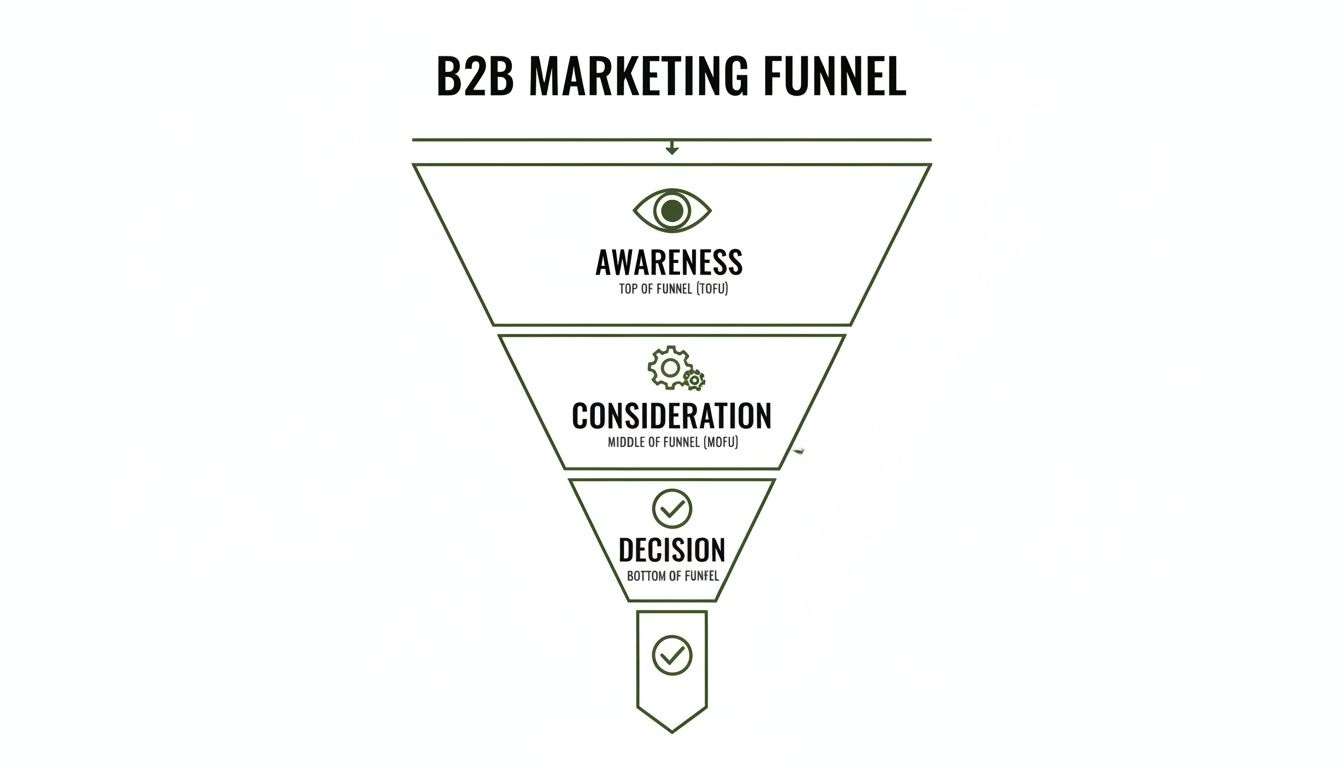
As people move deeper, their questions get more specific. Your content has to evolve with them, shifting from broad, helpful advice to laser-focused information about your solution.
Stage 1: Awareness — Attracting the Right Audience
At the very top of the funnel (ToFu), your audience is just starting to realize they have a problem. They might not even have the words for it yet. They’re typing broad questions into Google, searching for answers and insights. Your job here is simple: get on their radar by being genuinely helpful.
This is not the time for a sales pitch. Your content should be educational, easy to find via search, and focused entirely on their questions. This is also where knowing your customer inside and out is non-negotiable. If you haven't nailed down your ideal customer profiles, our guide on how to create buyer personas is a great place to start.
Top-of-funnel content that works:
- SEO-Driven Blog Posts: Articles that answer "how to," "what is," and "why" questions, optimized for the exact phrases your audience is searching for (e.g., "how to improve team productivity").
- Industry Reports & Whitepapers: Data-rich resources that position you as a thought leader and provide incredible value, helping you stand out from the noise.
- Informative Videos & Podcasts: Great for breaking down complex ideas into something digestible. Channels like YouTube and LinkedIn are perfect for this.
Stage 2: Consideration — Nurturing and Educating Prospects
Okay, so they know they have a problem. Now what? In the middle of the funnel (MoFu), they’re actively researching and comparing potential solutions. They’ve moved from "What is my problem?" to "How can I solve this problem?" Your goal is to build trust and prove that your approach is the best one.
Your content needs to get more specific here. It's time to show them how you solve their pain points and why your way is better.
The Consideration stage is all about building confidence. Your prospects are weighing their options, so you need to give them clear, compelling evidence that you're the right choice.
To guide them through this evaluation, lean on content like:
- Webinars and Live Demos: These are fantastic for showing your product in action. The interactive format lets you address their specific questions and objections in real-time.
- In-Depth Case Studies: Nothing builds trust like a real-world success story. Show them how you helped a company just like theirs achieve tangible results.
- Comparison Guides: Don't be afraid to compare your solution to competitors. An honest, detailed guide helps prospects make a truly informed decision and positions you as a transparent partner.
Stage 3: Decision — Closing the Deal
Welcome to the bottom of the funnel (BoFu). Your prospect is ready to pull the trigger. They’ve narrowed their list down to just a few options (hopefully including you!), and they're looking for that final nudge of confidence to sign on the dotted line. Your job is to make it an absolute no-brainer to choose you.
The content here is all about removing friction and risk. Answer their final questions, showcase your value, and make the next step crystal clear. A well-designed pricing page on your Webflow site, for instance, with clear feature tiers and glowing testimonials, can be the final piece of the puzzle.
Powerful content for this stage includes:
- Product Demos and Free Trials: Let them kick the tires. A hands-on experience is often the most convincing argument you can make.
- Client Testimonials and Reviews: Social proof is everything. Let your happy customers do the selling for you through authentic, powerful feedback.
- Implementation Guides and Pricing Pages: Give them the practical details they need. Be upfront about costs, onboarding, and the return on their investment.
Stage 4: Retention — Turning Customers into Advocates
The sale is not the end of the journey—it’s the beginning of a new one. The Retention stage is where you turn a new customer into a loyal fan who sticks around for the long haul. A great retention strategy slashes churn and, even better, creates brand advocates who bring you new business.
It all comes down to the post-purchase experience. By continuing to deliver value, you create a powerful flywheel where your best customers become a source for feeding the top of your funnel. It's also worth noting how different channels perform; for example, organic search and email often drive 2.5-3% conversions, while PPC is closer to 1.5-2%. Understanding these B2B SaaS funnel conversion benchmarks can help you allocate resources more effectively across the entire customer lifecycle.
Content that keeps customers happy and engaged:
- Customer Onboarding Guides: Set them up for success from day one with clear tutorials and resources that help them get value, fast.
- Exclusive Content and Training: Offer advanced webinars or workshops just for customers. Help them become power users of your product.
- Community Forums and User Groups: Create a space where customers can connect, share tips, and learn from each other. It builds a powerful sense of belonging.
Building Your Funnel Inside a Webflow Site
So, we've talked about the theory behind the B2B marketing funnel. Now, let's get our hands dirty and turn that blueprint into a real, revenue-generating machine. For a growing number of B2B companies, Webflow is the perfect tool for the job. It offers a powerful mix of design freedom, a killer CMS, and the performance you need to build a smooth customer journey from first touch to final handshake.
Think of your Webflow site as the physical architecture for your funnel. This isn’t just about making things look pretty; it's about engineering a pathway. Every page, form, and button has a specific role in nudging prospects from one stage to the next. Let's walk through how to actually build this system right inside Webflow.
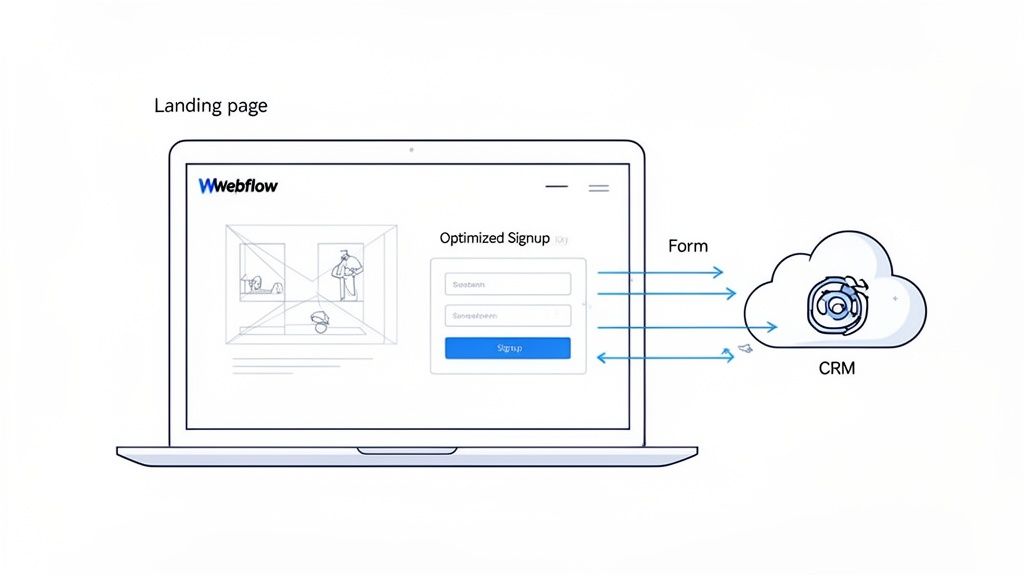
Designing High-Converting Landing Pages
Every single stage of your funnel needs its own dedicated landing page. Whether it’s a top-of-funnel blog post attracting new eyeballs, a mid-funnel webinar signup capturing interested leads, or a bottom-of-funnel demo request, the goal is always the same: clarity, focus, and a can't-miss call-to-action (CTA).
With Webflow, you have total control to build pages that are designed to convert. Here are a few practical tips to get you started:
- Remove Navigation on Key Pages: For high-intent landing pages, like a demo request, you can create a separate "landing page" folder in Webflow. Then, create a unique Symbol for the header and footer in that folder that doesn't include the main navigation. This creates a tunnel-vision experience, minimizing distractions and keeping the user focused on the one action you want them to take.
- Use Social Proof Strategically: Don't just bury your best testimonials on a separate page. Use Webflow’s layout tools like Flexbox or Grid to weave client logos, glowing reviews, and impressive case study snippets directly onto your landing pages. You can even use the Webflow CMS to pull in testimonials dynamically, ensuring your social proof is always fresh.
- Optimize for Speed: Nothing kills a conversion faster than a slow-loading page. Did you know a site that loads in 1 second has a conversion rate 3x higher than a site that loads in 5 seconds? In Webflow, go to your Assets panel and ensure all large images are compressed. Use the native responsive image functionality to serve smaller images on mobile devices, and set images below the fold to "Lazy load" in the Element Settings panel.
Scaling Content with the Webflow CMS
Content is the fuel for your B2B marketing funnel, and the Webflow CMS is the engine that helps you produce it at scale. Instead of tediously building every blog post or case study as a static, one-off page, the CMS lets you create structured "collections" for different types of content.
This is a game-changer for funnel efficiency. For instance, you could build a "Case Studies" collection with specific fields for the client's name, their core challenge, your solution, and the amazing results you delivered. Once that's set up, your marketing team can publish new success stories whenever they want, without ever needing to bug a designer or write a single line of code.
Actionable Tip: Create separate CMS collections for each content type in your funnel (Blogs, Case Studies, Whitepapers, Webinars). For each collection, build a template page. In the page settings for that template, you can dynamically pull in the item's name for the Title Tag and a summary field for the Meta Description, automating your on-page SEO.
By structuring your key funnel assets—like blogs, case studies, and webinars—within the Webflow CMS, you create a scalable system that allows your marketing team to consistently publish optimized content, fueling every stage of the buyer's journey without technical bottlenecks.
Of course, to manage all this new content, you need a solid process. For a great breakdown on how to keep your team organized, check out this guide on creating an efficient content production workflow.
Optimizing Forms for Seamless Lead Capture
Your forms are the gatekeepers of your funnel. This is the moment a curious, anonymous visitor raises their hand and becomes a known lead. A clunky, confusing, or ridiculously long form is the fastest way to spring a leak in your funnel and lose a great prospect forever.
Webflow’s native forms are incredibly flexible and can be styled to perfectly match your brand. To get the most out of them:
- Ask for Less, Not More: For a top-of-funnel newsletter signup, all you need is an email address. For a mid-funnel asset like a whitepaper, maybe you ask for a name and company. Save the heavy-hitter questions (like company size or phone number) for those high-intent, bottom-of-funnel requests.
- Use Conditional Logic: In the Webflow Form Block settings, you can show or hide form fields based on what a user has already entered. For example, if a user selects "Other" in a dropdown, you can reveal a text field for them to provide more detail. This makes the form feel more conversational.
- Provide Clear Error Messaging: We've all been there—you hit submit, and a vague "error" message pops up. Style your form's "Error State" directly in the Webflow Designer. Make the error text red, clear, and place it right next to the problematic field so users know exactly how to fix it without starting over.
Integrating Your Funnel with Essential Tools
Your Webflow site is powerful, but it doesn't work in a silo. To run a truly effective B2B marketing funnel, you need to connect it to your CRM and marketing automation platforms. This is how you track leads as they move through the funnel, nurture them with targeted emails, and signal the sales team when it's the perfect time to reach out.
The most common integrations for a B2B funnel usually fall into these categories:
Tool CategoryExample PlatformsPrimary Function in Webflow FunnelCRMHubSpot, SalesforceThis is your central nervous system. It manages all lead data, tracks interactions, and acts as the single source of truth for your sales team.Marketing AutomationMarketo, Pardot, ActiveCampaignThis is your nurturing engine. It sends automated email sequences to leads based on the specific actions they take on your Webflow site.AnalyticsGoogle Analytics 4, HotjarThese tools help you see what's working and what's not. They track user behavior, pinpoint where people are dropping off, and give you the data you need to optimize.
Webflow plays nicely with these tools. For many integrations, like HubSpot, you can use the form's "Action" URL to send data directly. For others, a tool like Zapier is your best friend. You can create a "Zap" that triggers every time a Webflow form is submitted, automatically creating or updating contacts in your CRM. This automation is what transforms your website from a simple brochure into a predictable, lead-generating machine.
How to Optimize Your Funnel with SEO and CRO
Getting your B2B marketing funnel built is a massive accomplishment, but the job isn't done. It’s definitely not a "set it and forget it" kind of project. The real, lasting growth happens when you start optimizing.
Think of your funnel like a system of pipes carrying water. Even a tiny leak somewhere along the line can lead to a huge loss of pressure—and potential revenue—over time.
To plug those leaks and get more customers flowing through, you need to pull two powerful levers: Search Engine Optimization (SEO) and Conversion Rate Optimization (CRO). These two work hand-in-hand. SEO brings more of the right people into your funnel, and CRO convinces more of them to take the next step. When you approach them together, the results really start to compound.
Conversion Rate Optimization Essentials
CRO is all about making it easier for visitors to do what you want them to do on your site, whether that’s downloading an ebook, signing up for a webinar, or booking a demo. It’s the art and science of removing friction and making the next step obvious and appealing.
Good CRO is built on data, not guesswork. You can’t fix a problem you don’t understand. Tools like heatmaps (from services like Hotjar) are brilliant for this; they show you exactly where people are clicking and scrolling. You can quickly see which parts of your page are grabbing attention and which are getting completely ignored.
Once you have some insights, you can start running tests. Some of the most effective CRO tactics include:
- A/B Testing Headlines and CTAs: Use a third-party tool like Google Optimize or VWO by adding their script to your Webflow site's custom code area. This lets you test different versions of your headlines and call-to-action buttons without having to create duplicate pages.
- Simplifying Forms: Every field you ask someone to fill out is another chance for them to give up. Cut your forms down to the absolute essentials.
- Improving Page Speed: Slow pages are absolute conversion killers. Use the performance tools built right into Webflow to make sure your key funnel pages load in a snap.
Conversion Rate Optimization isn't about chasing trends or throwing spaghetti at the wall. It's a methodical process: use data to understand your users, form a hypothesis, test your change, and measure the results to systematically improve your funnel.
It's also important to remember that conversion rates are all over the map depending on the industry. The average B2B website might see a 2-5% conversion rate, but we’ve seen professional services firms hit as high as 10%, while SaaS and tech often hover between 1-3%. This just goes to show why a one-size-fits-all approach doesn't work.
Webflow-Specific SEO for Funnel Health
Great SEO is what keeps your funnel topped up with a steady stream of qualified prospects. If you’re using Webflow, you’re in a great position. The platform gives you incredible, granular control over all the technical bits that search engines pay attention to.
Your main goal here is to make it dead simple for Google to find, understand, and rank your content for the phrases your ideal customers are typing into the search bar.
Mastering Metadata in the Webflow Editor
Webflow takes the headache out of managing your on-page SEO. For every single page—and especially for your CMS Collection templates like blog posts or case studies—you need to nail down these details:
- Title Tags: This is your most important on-page ranking factor. Make it compelling and be sure to include your main keyword. Inside Webflow, you can even dynamically pull the name of a CMS item (like a blog post title) right into the title tag field.
- Meta Descriptions: This isn’t a direct ranking factor, but it’s your ad copy in the search results. A great meta description convinces people to click on your link instead of someone else's.
- URL Slugs: Keep your URLs clean, descriptive, and keyword-rich. Webflow creates these for you based on the page name, but you can—and should—tweak them for clarity.
Ensuring Dynamic CMS Content Gets Indexed
The Webflow CMS is a powerhouse for scaling your content production. But all that amazing content is useless if search engines can't find it.
Pop into your Webflow Settings > SEO. Make sure Auto-generate Sitemap is toggled ON. This ensures Google is notified of new content. Then, review your robots.txt file. Unless you have specific pages you need to hide (like an internal dashboard), it should generally be set to User-agent: * Allow: /. This gives search engines full access to crawl your site.
For a deeper dive, our guide on conversion rate optimization strategies has even more practical tips.
By combining smart CRO with disciplined, Webflow-specific SEO, you turn your funnel from a static diagram into a dynamic growth engine. And as you look to the future, getting a handle on essential AI SEO tactics is quickly becoming a critical piece of the puzzle.
Measuring Funnel Success With Key Metrics and KPIs
You can't improve what you don't measure. It’s an old saying, but it’s the absolute truth in marketing. Building a sophisticated B2B funnel on your Webflow site is a great first step, but without the right data, you’re just guessing.
To really dial things in, you have to move beyond vanity metrics and focus on the Key Performance Indicators (KPIs) that show you the real health of your funnel, from top to bottom. This is how you spot the leaks, double down on what’s working, and prove your marketing is driving revenue, not just costs.
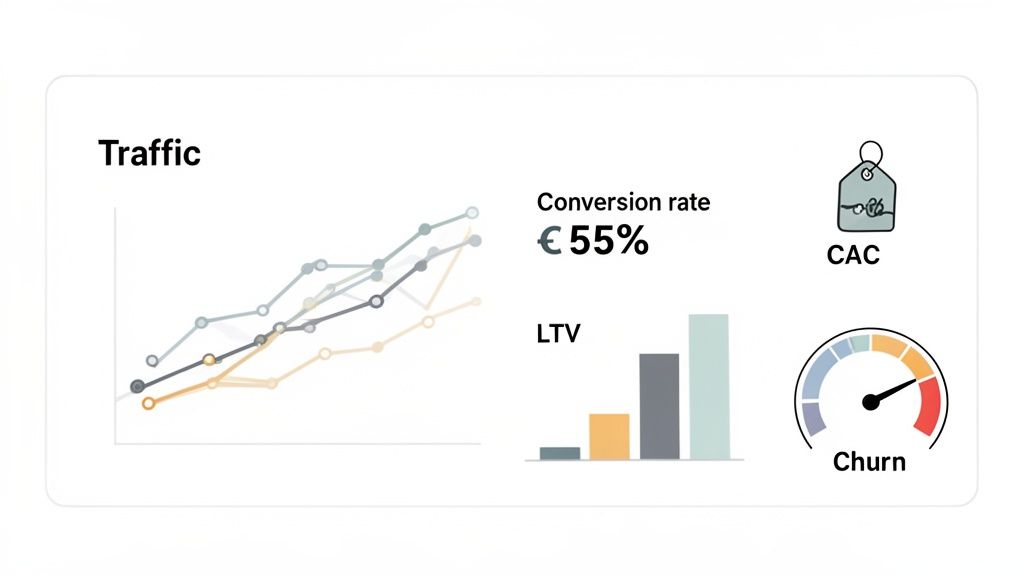
Tracking KPIs isn't just about looking at numbers on a screen; it’s about understanding the story they tell. Each stage of the funnel has its own set of critical metrics that reveal how effectively you're moving buyers toward a purchase.
Essential KPIs for Each B2B Funnel Stage
Let's break down what these actually mean for your day-to-day operations.
Key Metrics for the Awareness Stage
At the very top of your funnel, the main goal is simply to get in front of the right people. Your KPIs here should reflect how well you're capturing their attention and pulling them into your world. Forget just counting page views; you need to know if the right traffic is showing up.
- Organic Traffic: Are more people finding you through search engines this month than last? This tells you if your SEO work is paying off.
- Keyword Rankings: Keep an eye on your position for those high-value keywords. When you start climbing the ranks for terms your ideal customers search for, you know you're becoming more visible.
- Bounce Rate: This is the percentage of visitors who land on a page and leave without clicking anything else. If your key blog posts or landing pages have a high bounce rate, it might be a sign that your content isn't matching what visitors expected to find.
Tracking Success in the Consideration Stage
Once someone knows you exist, the game changes. In the consideration stage, it's all about engagement and figuring out who the serious prospects are. The metrics here reveal how well you’re building trust and turning anonymous visitors into actual leads.
This is where you shift your focus to KPIs that measure lead generation and efficiency:
- Lead Conversion Rate: This is the big one. What percentage of visitors are actually taking action, like downloading your ebook or signing up for a webinar? This is a direct report card on how compelling your content is.
- Cost Per Lead (CPL): How much are you spending to get one person to raise their hand? This metric is absolutely crucial for managing your budget and understanding the real-world efficiency of your campaigns.
By tracking conversion rates and CPL, you can pinpoint which content assets and channels are most effective at turning anonymous traffic into qualified leads, allowing you to allocate your resources for maximum impact.
For a powerful way to boost your conversion rates, especially in B2B, think about using chatbots for lead generation and conversion. They can engage visitors and qualify leads around the clock.
Measuring the Decision and Retention Stages
Now we’re at the bottom of the funnel, where marketing efforts turn into actual revenue. These are the metrics your CEO and Head of Sales are watching because they connect your work directly to business growth.
Key metrics for the Decision stage include:
- Demo Requests or Trial Sign-ups: This is a huge buying signal. It means a lead is past the research phase and is ready to talk business.
- Customer Acquisition Cost (CAC): What’s the total sales and marketing cost to bring in one new customer? A sustainable business needs a low CAC compared to the value that customer brings in over time.
But the job isn’t over once the contract is signed. Keeping customers happy is just as important as finding them.
Retention metrics show you how well you’re delivering on your promises:
- Churn Rate: What percentage of customers are leaving you each month or year? High churn is a silent killer for B2B companies.
- Customer Lifetime Value (LTV): This is the total amount of revenue you can expect from a single customer over their entire relationship with you. The golden rule is simple: your LTV must be significantly higher than your CAC.
By keeping a close eye on these KPIs, you can get a complete, 360-degree view of your funnel’s performance and make smart decisions that lead to real, sustainable growth.
A Few Common B2B Marketing Funnel Questions
Even with a solid plan, a few questions always pop up when you're in the trenches building and managing a B2B funnel. Let's tackle some of the most common ones.
How Long Does a B2B Funnel Take?
This is the classic "it depends" answer, but for good reason. A B2B sales cycle can be surprisingly short—maybe a few weeks for a simple SaaS tool—or it can stretch out for a year or more for a major enterprise platform.
The timeline really hinges on a few things: your product's price tag, how many people need to sign off on the purchase, and the industry you're in. A well-designed marketing funnel isn't built for speed; it's built to adapt and keep nurturing leads throughout that entire journey, however long it takes.
The goal isn't necessarily speed, it's momentum. Your funnel needs to keep the conversation going and deliver value at every turn, so you stay top-of-mind from their first Google search to the final contract signing.
What’s the Main Difference Between a B2B and B2C Funnel?
On the surface, they look similar—awareness, consideration, decision. But how you approach them is worlds apart. B2B funnels are longer and far more complex because you're not selling to one person; you're often selling to a whole committee. The price points are higher, and the final decision is based on logic, ROI, and cold, hard data.
B2C funnels, on the other hand, are usually much shorter. They're often driven by emotion and impulse. This is a huge distinction. It means your B2B content has to focus relentlessly on education, data, and building trust over the long haul. B2C marketing can often get away with focusing on brand hype, flash sales, and creating an immediate "I want that" feeling.
How Can I Fix a Leaky Funnel on My Webflow Site?
Finding and plugging leaks is where the real optimization magic happens. Your first job is to play detective. Use analytics and tools like heatmaps to see exactly where people are getting stuck or dropping off your site.
Once you know where the leaks are, you can start patching them. On a Webflow site, the usual suspects are:
- Slow Page Load Speeds: Even a one-second delay can send a potential lead packing. Dive into Webflow’s settings to optimize your images and clean up your scripts.
- Confusing Navigation: If people can't find what they're looking for, they won't stick around to figure it out. Make sure your site map is intuitive and your most important pages are easy to get to.
- Overly Complex Forms: Asking for a prospect's life story on the first form is a classic conversion killer. Strip your forms down to the absolute essentials for that specific stage.
- Unclear Calls-to-Action (CTAs): Your buttons need to be impossible to ignore. They should be clear, action-oriented, and tell the visitor exactly what happens next.
By working through these weak spots one by one and A/B testing your changes, you can stop losing valuable leads and seriously improve your funnel’s performance.
Ready to turn your Webflow site into a predictable revenue engine? At Block Studio, we build and manage complete B2B marketing funnels—from SEO and content to conversion optimization—so you can focus on growth. Get a clear plan to attract and convert more qualified leads.